

For fans of the Namibian night sky, it's worth getting up early in May. The morning sky offers a meteor shower and two planets. In the evening, two planets can be seen. Additionally, there is a rare (yet insignificant) 'Blue Moon' in May.
The meteor shower is the Eta Aquariids (see article on Wikipedia). Its center is located near the star Eta Aquariid in the constellation Aquarius.
From 19 April to 28 May, Earth passes through the belt of small debris left behind by Halley's Comet. Falling through Earth's atmosphere, these small fragments burn up, becoming meteors, also known as shooting stars.
The Eta Aquariids are most active on the night of 5 to 6 June. On average, 50 meteors per hour can be observed (see TimeAndDate.com).
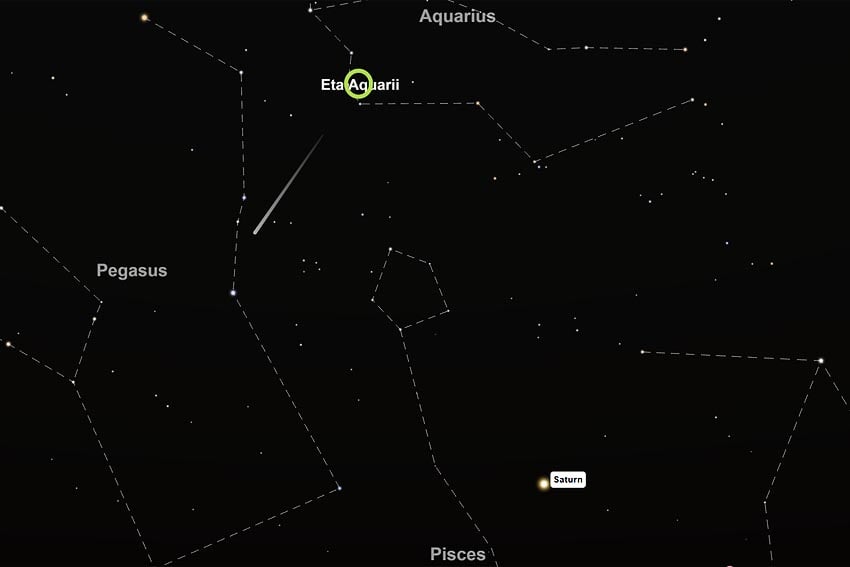
Center of the Eta Aquariid meteor shower high above Saturn: The morning sky on 6 May 2026 at 5:30 am, as seen from Windhoek, looking east-northeast. Image: Screenshot from interactive star chart on TimeAndDate.com
The center of the meteor shower rises around 2:30 am and is high in the east-northeast in the early morning. Saturn, which rises shortly after 4:00 am, can be used as a reference point. It is obviously located much lower and a bit further east, but is very conspicuous (see graphic).
In October, the Earth crosses Halley's debris belt again. Because by then the constellation Orion is in the background, the meteor shower is called the Orionids.
Four planets showing up
Of the five planets that can be observed with the naked eye, two are in the morning sky. Saturn rises around 4:05 am and Mars can be seen on the eastern horizon from about 5:15 am (these times refer to 15 May; see TimeAndDate.com).
Two more planets can be spotted in the evening sky. Venus sets around 8:15 pm, followed by Jupiter around 10:10 pm. Mercury is not visible in May. From Earth's perspective, it is behind the sun and therefore rises and sets practically at the same time.
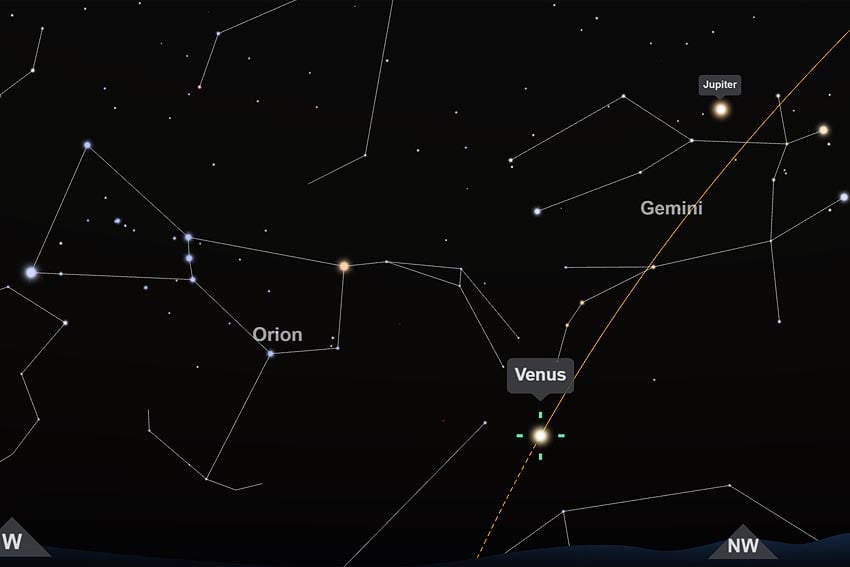
The planets Venus and Jupiter, as well as the constellations Gemini and Orion: The evening sky on 15 May 2026 at 7:30 pm, as seen from Windhoek, looking west-northwest. Image: Screenshot from interactive star chart on TimeAndDate.com
As rare as insignificant: 'Blue Moon'
In May, we experience two full moons: on 1st and 31st of May. Those who attach special significance to this call the second full moon within a month a 'Blue Moon' (see TimeAndDate.com).
Admittedly, this does not happen very often. The last 'Blue Moon' was on 30 August 2023, and the next one will not occur until 31 December 2028.
But ultimately, the intervals between months are arbitrarily determined by humans. How often the moon reaches the full moon position within one of these intervals as it orbits the Earth is of little interest to astronomers.
What is likely more interesting is that the full moon on 31 May will be the smallest of the year. On 1 June the Moon will reach its farthest point from Earth (about 406,000 km) in its elliptical orbit. When it is closest to Earth (around 360,000 km), it appears 14 percent larger and 30 percent brighter.
Sun and Moon
Sunrise on 1 May is around 7.10 am, sunset around 6.25 pm. On 31 May, the sun rises at around 7.23 am and sets at around 6.14 pm. The length of the day (time with sunlight) will therefore decrease by 24 minutes over the course of the month – from 11 hours 15 minutes to 10 hours 51 minutes (see TimeAndDate.com).
The phases of the moon in May: full moon 1 May 2026, last quarter 9 May, new moon 16 May, first quarter 23 May, second full moon 31 May 2026. Therefore, the nights in mid-May have the least moonlight, which could interfere with the observation of stars and planets.
You can also find out more about the Namibian starry sky in May 2026 in the Astro News by Lutz von Dewitz in the news section on the website of the Namibia Scientific Society.



.png?width=82&height=85&name=Navigate%20Namibia-03%20(1).png "Navigate Namibia")
SUBMIT YOUR COMMENT