

The highlight of the April night sky is undoubtedly the Lyrid meteor shower. But the 'meeting' of the Moon and three planets in mid-April also rewards early risers. Meanwhile, two comets crown the extended sundowner.
The Lyrids can be observed from mid to late April. Their radiant (centre) rises shortly after midnight and is high in the north in the early morning. It is located near the constellation Lyra – hence the name. The meteor shower reaches its peak activity on 22 and 23 April, with up to 18 shooting stars per hour (see TimeAndDate.com).
According to historical Chinese texts, the Lyrids were noticed already more than 2,500 years ago. The meteors are small fragments of Comet Thatcher that burn up in the Earth's atmosphere.
The Earth passes through this debris belt every April. And Thatcher, in its orbit around the sun, drops by roughly every 415 years – the next time in 2276. Maybe best to mark it in your calendar right now ;))
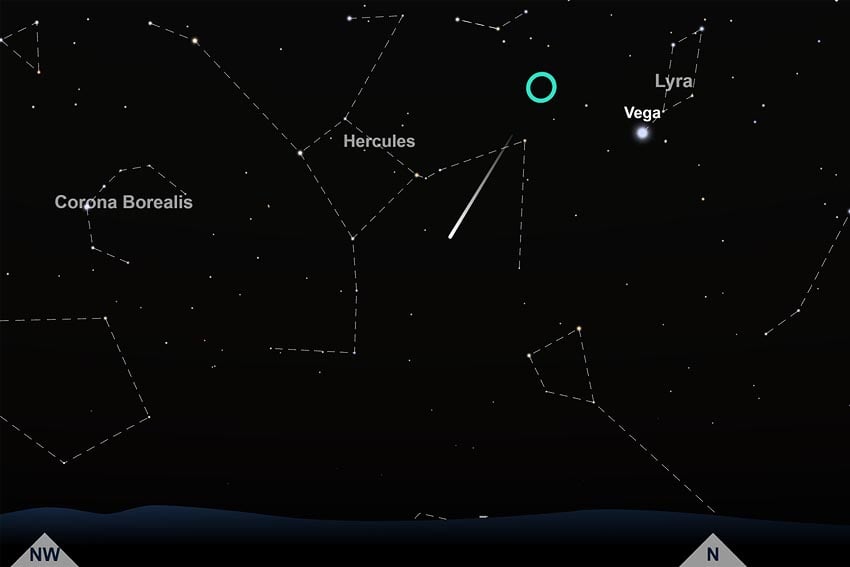
The radiant of the Lyrid meteor shower, the area from which the shooting stars appear, is located near the constellation Lyra. One can easily find it via its bright star Vega. - Depiction of the night sky over Windhoek on April 23, 2026, at 5:30 a.m., looking north. Image: Screenshot from TimeAndDate.com
Moon meets Mercury, Mars and Saturn
On 16 April, the night sky provides yet another reason to get up early. Around 6:10 a.m., Mercury, Mars and Saturn will meet the Moon (see TimeAndDate.com). As the Moon, one day before the new moon, is only a very thin crescent, it will not outshine the distant planets.
The four celestial bodies can be seen low in the east on the horizon. Provided you have a clear view and no mountains obscure the area of the celestial 'meeting'. Unfortunately, the sun is not far. Around 6:20 a.m., twilight begins, so the crescent moon and planets quickly disappear in the increasing light.
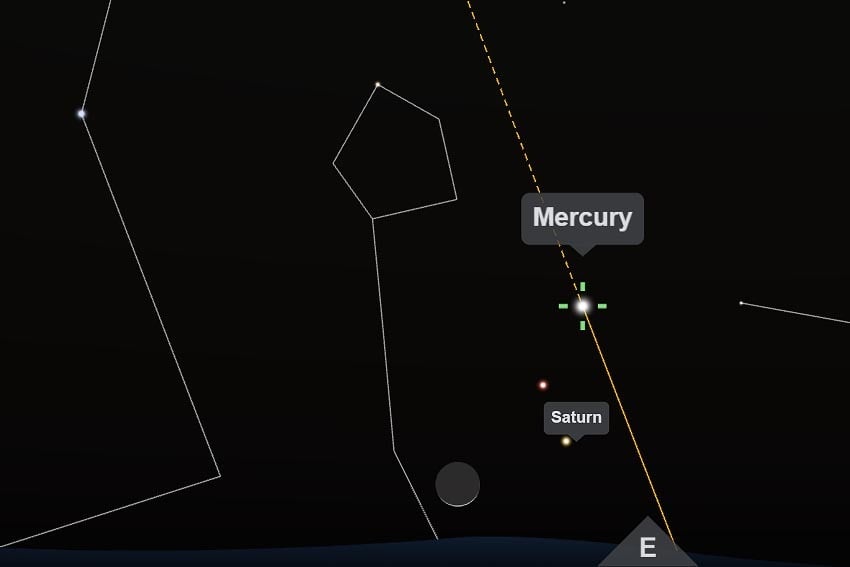
Apparent 'meeting' of four celestial bodies: Mercury, Mars, Saturn and the Moon. - Depiction of the night sky over Windhoek on 16 April 2026, at 6:10 a.m., looking east. Image: Screenshot from TimeAndDate.com
Anyone who looks at the same time every morning and notes the position of the planets will notice that they are moving. Mercury is a little lower in the sky each day. Saturn, on the other hand, is only visible from the middle of the month and rises a little by the day.
Comets MAPS and Wierzchos greeting after the sundowner
The remaining two planets visible to the naked eye are hanging out on the evening sky. Venus, as seen from Earth, is close to the sun and sets shortly after it in the west. Jupiter is high in the northwest after sunset, in the constellation Gemini, and bows out around midnight.
The main attraction at the end of the sundowner is likely to be two comets. They should be clearly visible once the afterglow of the sun fades. C/2026 A1 (MAPS), only discovered in January 2026, is located low in the west, west of the constellation Taurus. C/2024 E1 (Wierzchos) can be found between Taurus and Orion.
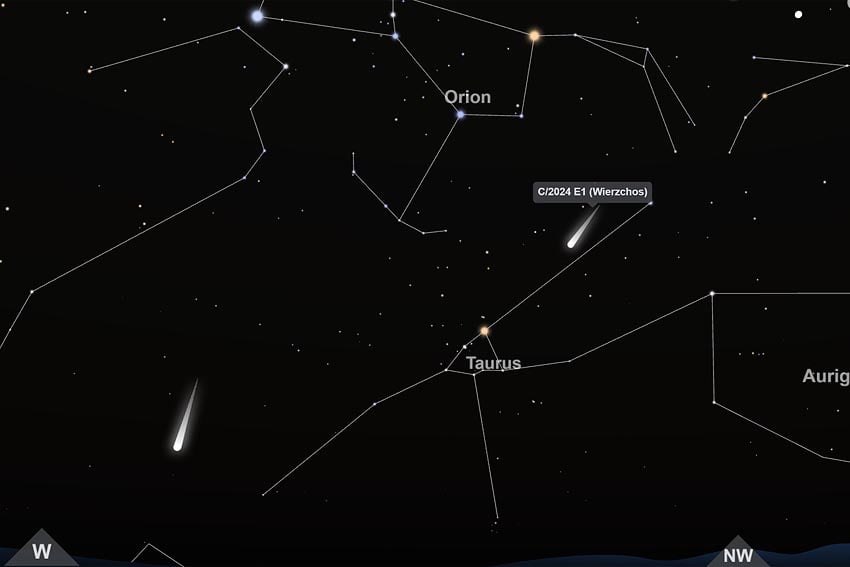
Comets C/2026 A1 (MAPS) and C/2024 E1 (Wierzchos) near the prominent constellations Taurus and Orion. - Depiction of the night sky over Windhoek on 15 April 2026 at 8:00 PM, looking west-northwest. Image: Screenshot from TimeAndDate.com
Sun and Moon
Sunrise on 1 April is around 6.59 am, sunset around 6.51 pm. On 30 April, the sun rises at around 7.10 am and sets at around 6.27 pm. The length of the day (time with sunlight) will therefore decrease by 35 minutes over the course of the month – from 11 hours and 52 minutes to 11 hours and 17 minutes (see Timeanddate.com).
The phases of the moon in April 2026: full moon 2 April, last quarter 10 April, new moon 17 April, first quarter 24 April. The moonlight is therefore the least disturbing when observing the stars and planets in the middle of April.
You can also find out more about the Namibian starry sky in April in the Astro News by Lutz von Dewitz in the news section on the website of the Namibia Scientific Society.

.png?width=82&height=85&name=Navigate%20Namibia-03%20(1).png "Navigate Namibia")
SUBMIT YOUR COMMENT