

In 2027, travelling in Namibia is expected to be just as safe as in Germany, Spain, the USA, Argentina or Malaysia. This is according to the 'Risk Map 2027' published by security firms Safeture and Riskline. The map illustrates the findings of their global risk analysis.
On the 'Risk Map' for 2027, Namibia is marked in light green – a colour representing 'low risk.' This classification by Safeture and Riskline is the same as the one given for the current year, 2026 (see report on Namibian.org).
The security scale consists of five levels. It ranges from 'critical risk' (wine red) to 'negligible risk' (dark green). With its light green colour, Namibia falls into the second-safest category.
For only a few countries do Safeture and Riskline assess the travel risk for the coming year as even lower. As in the current year, these include Canada, Portugal, Norway, Australia and Japan. Germany, by contrast, has been downgraded from dark green to light green.
According to Safeture and Riskline, they base their risk analysis on data from over 100,000 sources. They evaluate factors across four categories: political stability, security, health and environment.
The security category includes crime, while the health category covers medical care, diseases and sanitary conditions. Environmental factors assessed comprise natural disasters, such as earthquakes, floods or storms, as well as climate-related risks.
Low risk for travellers in Namibia
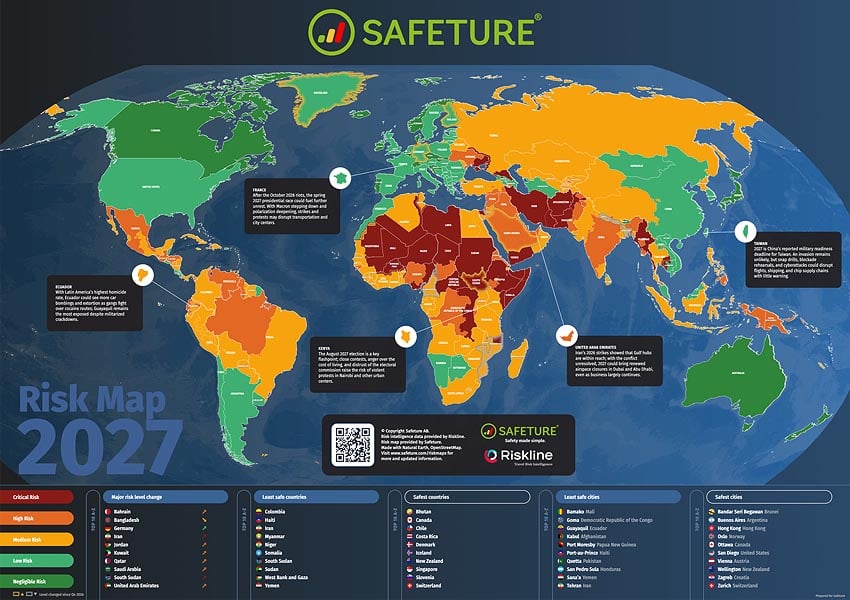
Namibia in light green. This is indicating a 'low risk' level on the 'Risk Map 2027' from Safeture and Riskline. Graphic: Safeture & Riskline
The 'Risk Map' does not specify how individual countries perform against each specific criterion. Namibia's placement in the second-safest category is likely due to crime, specifically theft and scams (see travel advice on Namibian.org).
In other areas, there are virtually no concerns. Namibia is politically stable. Aside from the risk of malaria in the north, against which one can easily take precautions, there are essentially no significant disease risks (see travel advice on Namibian.org). Travellers will find excellent sanitary conditions and a robust healthcare system.
Namibia is also largely free from natural disasters. Although the climate phenomenon El Niño can cause periodic dry spells (for more on climate see travel advice on Namibian.org), the country has adapted by investing in numerous reservoirs, water treatment facilities, and seawater desalination plants.
While flooding can occur following exceptionally heavy rainfall, such events remain localised. This includes swelling rivers along the northern and southern borders, pans and depressions filling up, and flood waves in dry riverbeds.

SUBMIT YOUR COMMENT