

In September 2026, the Namibian night sky appears particularly magnificent. Due to the Earth's position in its orbit around the sun, at night we look towards the centre of our galaxy, the Milky Way. The Southern Cross is also beautifully visible. Another astronomical event in September is the equinox, which marks the beginning of spring in Namibia.
Furthermore, four of the five planets in our solar system that can be seen with the naked eye show face. Only Mercury is hiding: It is so close to the sun that it can only be discerned low in the west in the evening. It sets shortly after the sun, around 7:50 PM.
Mars and Jupiter 'patrol' the morning sky. Mars rises around 3:30 AM, followed by Jupiter at 5:00 AM (all times are for 15 September 2026; see TimeAndDate.com).
Venus, on the other hand, makes its appearance as the 'evening star'. It emerges from the fading glow of the setting sun and sets at 9:40 PM. Saturn acts as a 'middleman'. It rises in the east around 8:05 PM and fades in the glow of the rising sun.
Moon 'meets' Mars, Jupiter, Venus, and Saturn
All four planets will be in conjunction with the Moon in September. Conjunction means that two celestial bodies come very close, but only seemingly so, as seen from Earth. In reality, the planets are, of course, very far from the Moon, with Saturn being the farthest away from the four.
The conjunction of the Moon and Mars can be observed in the early morning of 6 September 2026, and that of the Moon and Jupiter in the early morning of 8 September 2026. The Moon will come particularly close to Venus, appearing almost to embrace it. Their rendezvous will take place in the evening of 14 September 2026.
The conjunction of the Moon and Saturn on 27 September 2026, is not quite as impressive. On the day after the full moon, the Earth's satellite is still nearly full and thus outshines the ringed planet. However, their conjunction can be observed both in the evening from about 7:40 PM throughout the night to the morning before sunrise.
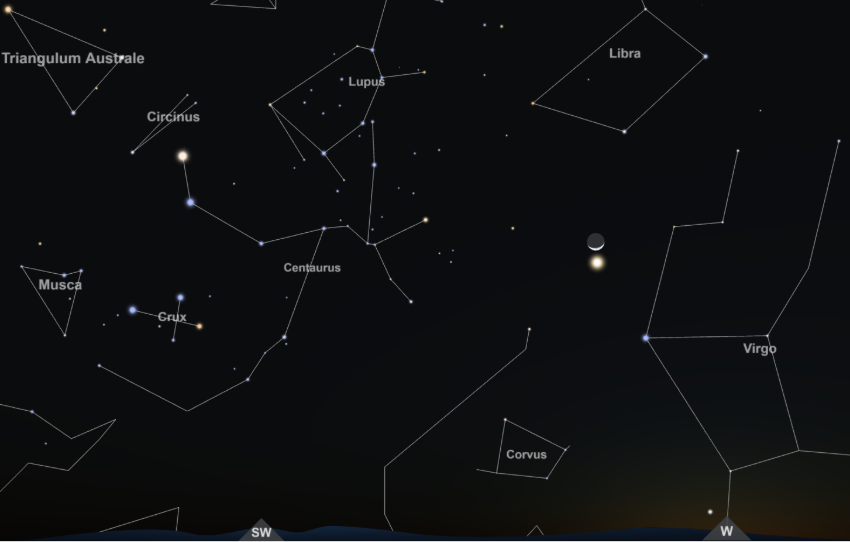
Moon embraces Venus on 14 September 2026: The evening sky at 7:30 PM, as seen from Windhoek, looking west-southwest. Graphic: Screenshot from interactive star chart on TimeAndDate.com
Sun and Moon
Sunrise on 1 September 2026 is around 7.02 AM, sunset around 6.41 PM. On 30 September 2026, the sun rises at around 6.33 AM and sets at around 6.50 PM. The length of the day (time with sunlight) will therefore increase by 38 minutes over the course of the month – from 11 hours and 39 minutes to 12 hours and 17 minutes.
On 23 September, everyone on Earth experiences a day with almost exactly twelve hours between sunrise and sunset. The day is therefore almost as long as the night. This phenomenon is called the equinox (Latin for 'equal night').
However, sunrise is defined as the appearance of the upper edge of the sun's disk, and sunset as its complete disappearance. Combined with the diffraction of sunlight in the atmosphere, this results in differences of several minutes depending on location on Earth.
In Namibia, 17 September 2026, has almost exactly 12 hours of sunlight. The following night is almost exactly 12 hours long between sunset and sunrise (see Timeanddate.com).
23 September 2026, also marks the beginning of spring in the Southern Hemisphere. In the Northern Hemisphere, however, autumn begins.
The phases of the moon in September 2026: last quarter 4 September, new moon 11, first quarter 18, full moon 26 September. Therefore, the nights in the first two thirds of September have the least moonlight, which could interfere with the observation of stars and planets.
You can also find out more about the Namibian starry sky in September 2026 in the Astro News by Lutz von Dewitz in the news section on the website of the Namibia Scientific Society.
Apropos: The Namibia Scientific Society (NSS) invites you to the 'Southern Star Party 2026' from 11 to 13 September 2026. For details check the Namibian.org report).
.png?width=82&height=85&name=Navigate%20Namibia-03%20(1).png "Navigate Namibia")
SUBMIT YOUR COMMENT