

January offers a special planetary alignment. Jupiter reaches its closest point to Earth, while Mercury, Venus, and Mars reach their farthest points. And Saturn is 'visited' by the Moon.
Jupiter is in opposition to the Sun on January 10. Meaning that the Earth has the Sun practically at its back when it faces Jupiter. At the same time, the two planets are at their closest points in their orbits.
This makes January an ideal time to take a closer look at the largest planet in our solar system. At sunset Jupiter is already high in the east in the constellation Gemini. And it fades low on the western horizon in the morning, fading in the increasing light of the rising sun.
In terms of volume, Jupiter is 1,320 times the size of the Earth. After the Sun, Moon and Venus, it is the fourth brightest object in the night sky (see also the Wikipedia article).
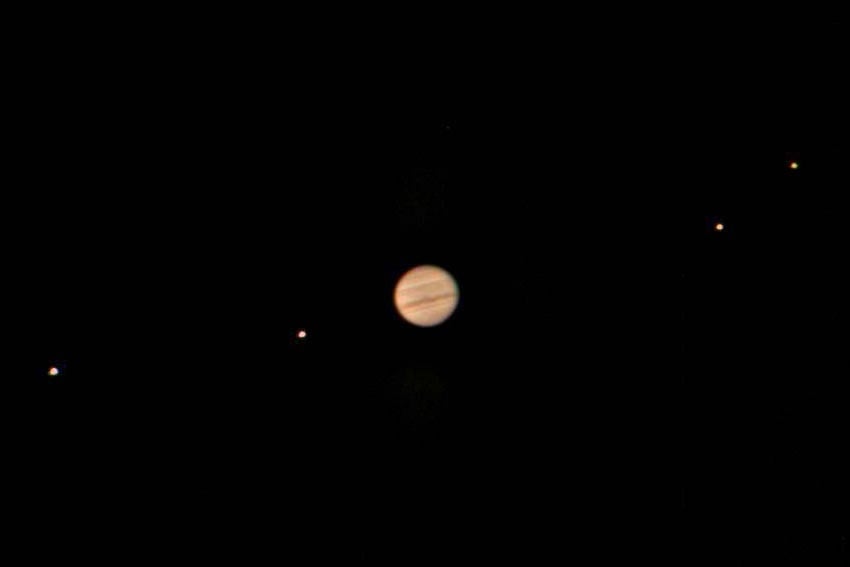
The gas giant Jupiter and its four Galilean moons Ganymede, Callisto, Io and Europa (in order of size). Photo: Jan Sandberg, Wikipedia
Nearly 100 natural satellites are known to orbit Jupiter (see also the Wikipedia article). Galileo Galilei discovered the four largest in 1610: Ganymede, Callisto, Io and Europa. They change their position during a night on Earth and can be seen with a telescope.
The discovery of these four Galilean moons shook the prevailing understanding of the universe at the time. Until then, it had been assumed that everything revolved around the Earth. Ganymede and its companions provided concrete evidence that this was not the case.
Saturn receives a visit from the Moon
Contrary to Jupiter, the planets Mercury (19 January), Venus (6), and Mars (9) reach their farthest points from Earth in January. From Earth's perspective, they are on the opposite side of the sun and are not visible. Venus will only show up again as from mid-January, appearing low in the west after sunset.
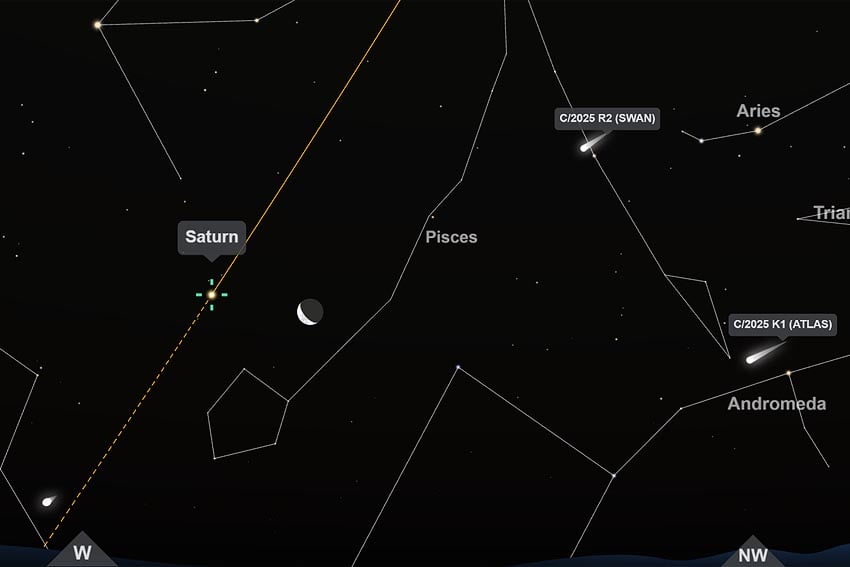
Saturn, Moon as well as comets C2025 R2 (SWAN) and C2025 K1 (ATLAS): The evening sky on 23 January 2026 at 9.15 p.m., as seen from Windhoek, looking west-northwest. Graph: Screenshot of an interactive star chart on TimeAndDate.com
The ringed planet Saturn is already in the west after sunset and sets shortly after 11.00 p.m. On 23 January, the waxing moon will make a very close approach to it.
With good binoculars, you should still be able to observe comets C2025 R2 (SWAN) and C2025 K1 (ATLAS). However, this will only be possible from shortly after 9.00 p.m. onwards (see graph; all times refer to 15 January and the location Windhoek; see TimeAndDate.com).
In the early morning, you might still be able to catch a glimpse of the Quadrantid meteor shower. Unfortunately, its center doesn't rise until around 5.00 a.m. in the northeast. The meteor shower reaches its peak on the full moon night of 3 January, with up to 120 meteors per hour.
Sun and Moon
Sunrise on 1 January is around 6.10 a.m., sunset around 7.39 p.m. On 31 January, the sun rises at around 6.31 a.m. and sets at around 7.38 p.m. The length of the day (time with sunlight) will therefore decrease by 22 minutes over the course of the month – from 13 hours and 29 minutes to 13 hours and 7 minutes (see Timeanddate.com).
The phases of the moon in January: Full moon 3 January, last quarter 10 January, new moon 18 January, first quarter 26 January. The moonlight is therefore the least disturbing when observing the stars and planets in the middle of the month.
You can also find out more about the Namibian starry sky in the Astro News by Lutz von Dewitz in the news section on the website of the Namibia Scientific Society.


.png?width=82&height=85&name=Navigate%20Namibia-03%20(1).png "Navigate Namibia")
SUBMIT YOUR COMMENT