

It's a mountain massif with Namibia's four highest peaks. It boasts 43,000 rock paintings dating back thousands of years. And it's home to incredibly diverse flora and fauna. Among them is the 'gladiator', which made headlines worldwide in 2002 because they had to create a new insect order for it.
Namibia is seeking to have this mountain massif and its surroundings inscribed on the World Heritage List. The Ministry of Education, Innovation, Youth, Sports, Arts and Culture (MEIYSAC) has submitted the formal application to the United Nations Educational, Scientific and Cultural Organisation (UNESCO).
UNESCO will now examine whether the requirements for World Heritage status are met. This primarily includes the protection of the area. As MEIYSAC Minister Sanet Steenkamp announced last week (see report in The Namibian), a decision is expected in July 2027.
Witness to breakup of ancient supercontinent Gondwana
Dâures means 'the burning mountain' in Khoekhoegowab. The light of the setting sun often gives the granite massif a reddish hue. Hence the Afrikaans and German name 'Brandberg'. Khoekhoegowab is the language of the Daman people who live there (often incorrectly referred to in the grammatical form for two persons as Damara).
The mountain massif bears witness to a momentous event in Earth's history. Around 130 million years ago, the supercontinent Gondwana broke apart. South America and Africa drifted away from each other. It was a time of super-volcanoes and magma flows.
The Dâures / Brandberg is the remnant of a gigantic magma bubble that rose to the surface but never reached it. Over millions of years, erosion has worn away the softer soil in the surrounding area. The magma, which has since solidified into granite, was exposed in the process.
Four peaks of the Dâures / Brandberg are the highest points in Namibia. Besides the 'Königstein' (2,573 m), there are the 'Horn' (2,519 m), 'Numasfels' (2,518 m) and 'Aigub' (2,501 m).
A haven for animals and humans
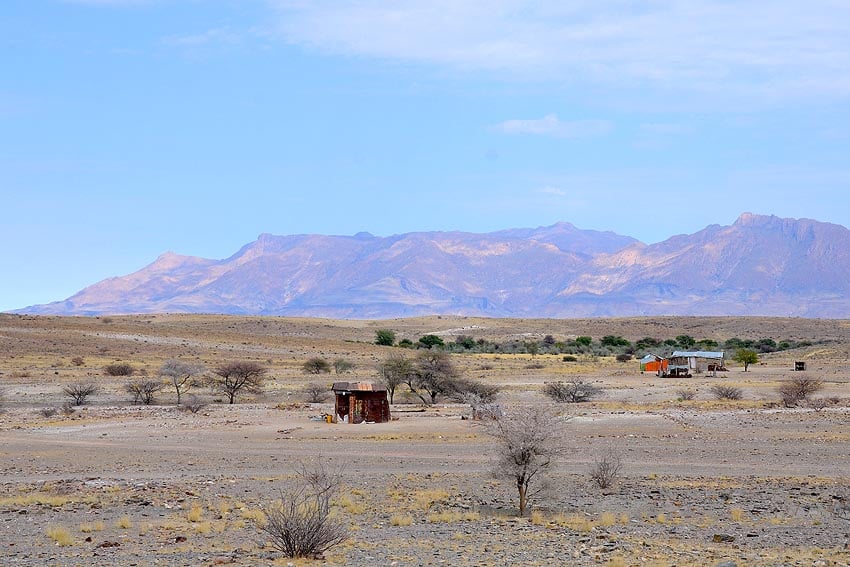
Dâures / Brandberg, for which Namibia has now formally applied to UNESCO for its inclusion on the World Heritage List. Photo (2014): Olga Ernst, Wikipedia
Located in the transition zone between the Namib Desert and the inland bush savannah, the Dâures / Brandberg is a biological hotspot. Among its 480 plant species are 100 species found only in Namibia, and seven are unique to the Dâures.
The wildlife is equally diverse. 82 different mammal species live in and around the mountain, representing 40 percent of Namibia's mammal species. With 128 bird species, the Dâures / Brandberg is also a paradise for birdwatchers.
Furthermore, the mountain massif is home to 2,000 insect species. 200 of these species have been found nowhere else in the world. Among them is the gladiator, whose discovery in 2002 caused a sensation. They even had to create a new insect order (Mantophasmatidae) for it.
Humans also made their home at Dâures / Brandberg. Nomadic hunter-gatherers found water, shelter and game here. More than 43,000 rock paintings, some up to 5,000 years old, bear witness to this. Perhaps the most famous motif is the 'White Lady', a figure likely depicting a male shaman with white body paint.
The 'White Lady' and the 'Desert Elephants' in the Ugab River, which flows to the north, attract many tourists. The Dâures / Brandberg is located near the popular route from Swakopmund via Twyfelfontein to Etosha National Park.
Protecting and promoting Dâures / Brandberg
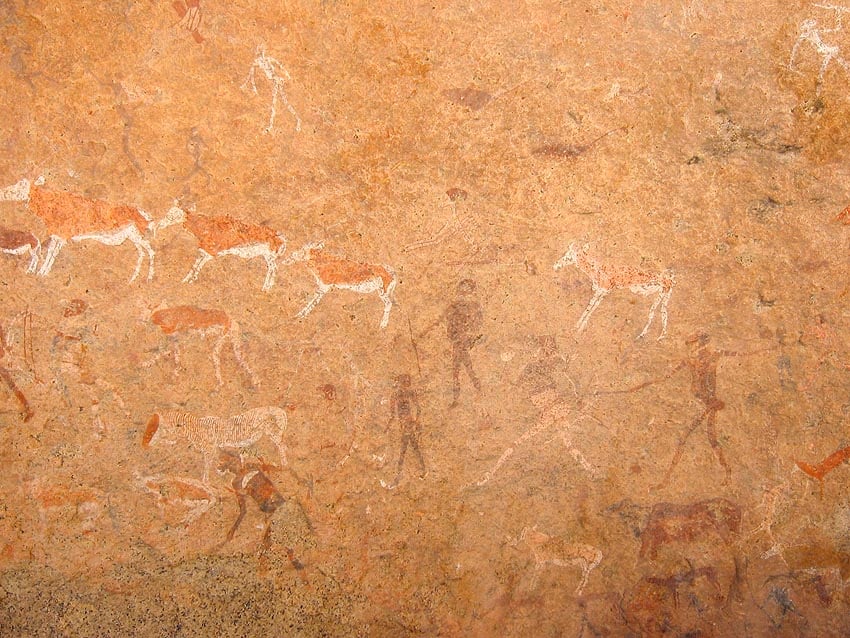
One of the thousands of rock painting motifs at Dâures / Brandberg, which Namibia intends to protect and promote even more effectively with its application for UNESCO World Heritage status: The famous, but already visibly faded 'White Lady'. Photo (2004): Harald Süpfle, Wikipedia
This rich geological, ecological, and cultural heritage has been under special protection since June 1951. At that time, the South African government declared a 450-square-kilometer area encompassing Dâures and its surroundings the 'Brandberg National Monument Area'.
Nevertheless, tourism and the mineral trade have taken their toll on the heritage. Reckless visitors have sprayed the 'White Lady' and other rock paintings with water to take more contrasting photographs. So-called 'small miners' search for topaz, amethyst, and other crystals to sell to tourists.
Since the early 2000s, tourists have only been allowed to visit the 'White Lady' with a local guide. A wooden walkway with railings was also constructed to keep visitors at a distance.
Now, the Namibian government intends to strengthen protection and increase the source of income for the local population. The World Heritage status is likely to bring a boost in additional visitors to Dâures / Brandberg.
Namibia's third World Heritage Site
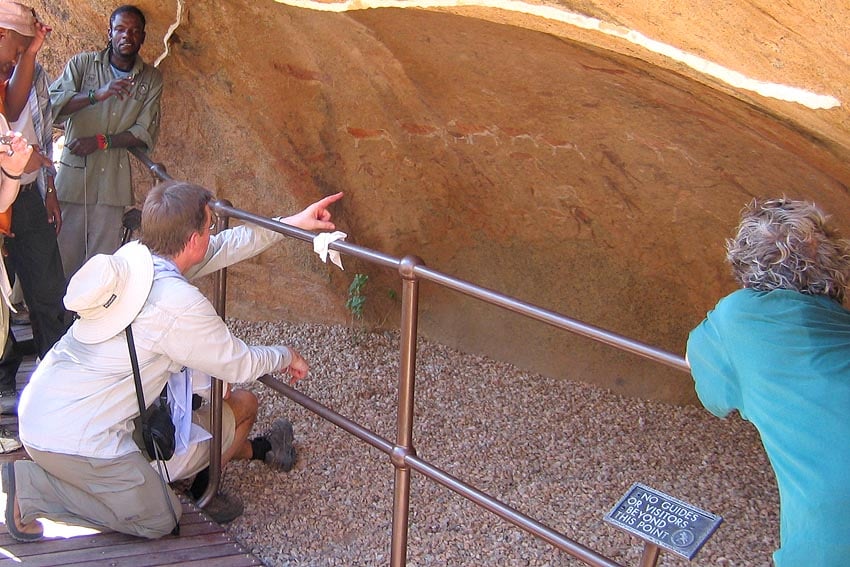
Protection from inconsiderate tourists: Wooden walkway, railings, and guide at the famous 'White Lady' at Dâures / Brandberg. Photo (2004): Sven-Eric Stender
Namibia had already placed Dâures on the tentative list of World Heritage Sites in October 2002 (see UNESCO website). This was in conjunction with the Fish River Canyon and the Welwitschia Plains east of Swakopmund.
Last September, the Cabinet approved the preparation of all necessary requirements for the formal nomination application to UNESCO. According to MEIYSAC Minister Steenkamp, the African World Heritage Fund provided financial and technical support for the preparations. Total costs: More than one million Namibia Dollar (currently just under 53,000 euros; amount based on the current exchange rate; 1 Rand = 1 N$).
If the UNESCO World Heritage Committee gives the green light for Dâures / Brandberg in July 2027, Namibia will have three World Heritage sites. Following Twyfelfontein (/Ui-//aes) with its thousands of rock engravings (2007) and the Namib Sand Sea with Sossusvlei and the world's highest dunes (2013).
More about the Dâures / Brandberg can be found in articles on Namibian.org and on Wikipedia.
.png?width=82&height=85&name=Navigate%20Namibia-03%20(1).png "Navigate Namibia")
SUBMIT YOUR COMMENT