

The solar eclipse on 12 August 2026, unfortunately will steer clear of Namibia. It will be visible practically only from the Northern Hemisphere. Nevertheless, there are still quite a few exciting events to observe in the Namibian night sky in August.
The main attractions will be offered by the morning night sky. Those who want to experience them will have to get up early. A partial lunar eclipse on 28 August 2026. The Perseid meteor shower until 24 August 2026. And three conjunctions of the Moon with planets on 4, 8 and 30 August 2026.
The lunar eclipse is partial, but impossible to miss. The Earth's umbra will cover 93 percent of the Moon when it reaches its maximum. Only a thin crescent will remain in the penumbra.
Here are the stages of the lunar eclipse on 28 August 2026, as seen from Namibia (see also the interactive night sky simulation at TimeAndDate.com):
3:23 a.m. - The Moon enters the Earth's penumbra.
4:33 a.m. - The partial eclipse begins. The Moon enters the Earth's umbra and darkens / turns reddish.
6:12 a.m. - The maximum of the eclipse is reached.
7:08 a.m. - The Moon sets. The subsequent phases, i.e., the Moon's exit from the umbra and penumbra, are no longer visible from Namibia.
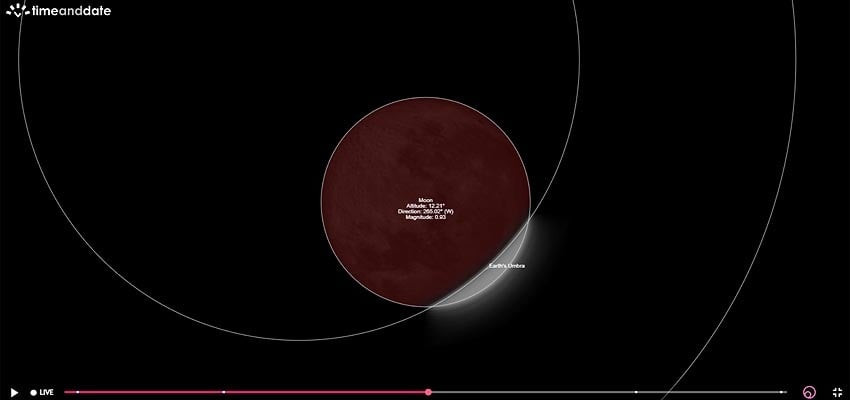
The partial lunar eclipse on 28 August 2026, as seen from Windhoek, in a descriptive simulation. The outer circle marks the penumbra, the inner circle the umbra of the Earth. Image: TimeAndDate.com
Perseid meteor shower
The Perseids are a meteor shower that occurs every year from 17 July to 24 August. During this time, the Earth passes through a belt in space containing debris particles from Comet 109P/Swift-Tuttle.
The Perseid meteor shower reaches its peak activity on the night of 12 to 13 August. Under favorable conditions, 60 to 100 meteors per hour can be observed. It is advantageous that the peak coincides with the new moon, so that moonlight does not interfere.
Unfortunately, the radiant of the Perseid meteor shower, as seen from the Southern Hemisphere, is very low in the sky. The radiant is the centre from which the meteors appear to originate. It rises around 3:30 a.m. and moves very slowly toward its highest point until sunrise.
Therefore, the meteors – the particles that burn up in the Earth's atmosphere – are best observed from about 6:00 a.m. onward. The silent spectacle fades around 6:45 a.m. in the glow of the rising sun. The Perseids can be found in the north-northeast, below the constellation Perseus.
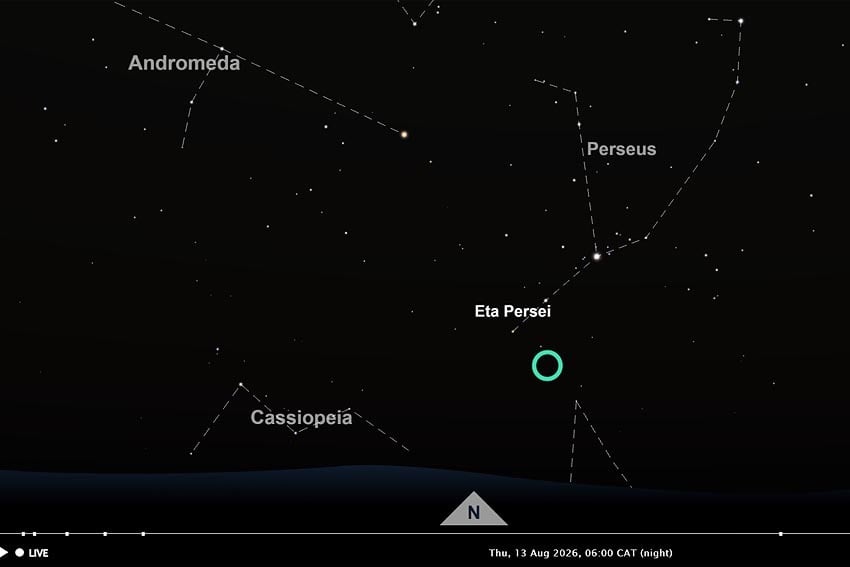
Centre of the Perseid meteor shower under the constellation Perseus at the peak of its activity on 13 August: The morning sky at 6:00 a.m., as seen from Windhoek, looking north-northeast. Graphic: Screenshot of interactive star chart on TimeAndDate.com
Mercury and Jupiter barely visible
Of the five planets visible to the naked eye, only three can be seen. Mercury and Jupiter rise almost simultaneously in the east around 6:35 a.m. That is only 40 minutes before sunrise (7:15 a.m.; times are for 15 August 2026; see TimeAndDate.com).
This also means that the rare event of the conjunction of Mercury and Jupiter is practically impossible to observe. Conjunction means that the two planets come very close to each other, but only seemingly so, as seen from Earth. In reality, Mercury orbits the Sun in orbit one, Jupiter in orbit five.
Saturn, in orbit six from the Sun, rises around 10:15 p.m. and is correspondingly high in the west in the morning. Mars, in orbit four, lags far behind and only appears on the eastern horizon from about 4:10 a.m.
Venus, in orbit two, is the only planet visible in the evening sky. Often referred to as the 'evening star', it sets around 9:55 p.m., shortly before Saturn rises in the east.
Apropos, the order of the planets is remembered by the mnemonic: "My Very Educated Mother Just Served Us Nachos." Mercury, Venus, Earth, Mars, Jupiter, Saturn, Uranus, Neptune. Pluto has been considered a minor planet since 2006 and is no longer included.
Moon meets Saturn, Mars, Venus and Saturn again
The Moon and Saturn will be in conjunction twice within four weeks. The first conjunction will occur on the night of 3 to 4 August 2026. Moonrise is around 11:00 p.m. The second conjunction will take place on the night of 30 to 31 August 2026, and will be visible as from moonrise at about 9:00 p.m.
The conjunction of the Moon and Mars on 8 August can only be observed in the early morning. The 'meeting point' is between the constellations Taurus and Gemini.
The Moon, ever the romantic, scheduled its rendezvous with Venus on 16 August 2026 for the evening. Venus will retire at about 9:40 p.m., the Moon, also ever the gentleman, will follow discretely about 20 minutes later. Scorpio, apparently jealous, will pinch it with its pincers on 20 August.
Sun and Moon
Sunrise on 1 August 2026 is around 7.25 am, sunset around 6.30 pm. On 31 August 2026, the sun rises at around 7.02 am and sets at around 6.41 pm. The length of the day (time with sunlight) will therefore increase by 19 minutes over the course of the month – from 11 hours and 5 minutes to 11 hours and 39 minutes (see Timeanddate.com).
The phases of the moon in August 2026: last quarter 6 August, new moon 12 August, first quarter 20 August, full moon 28 August. Therefore, the nights in the first two thirds of August have the least moonlight, which could interfere with the observation of stars and planets.
You can also find out more about the Namibian starry sky in August 2026 in the Astro News by Lutz von Dewitz in the news section on the website of the Namibia Scientific Society.
.png?width=82&height=85&name=Navigate%20Namibia-03%20(1).png "Navigate Namibia")
SUBMIT YOUR COMMENT