

Their calls sound like the gleeful giggles of cartoon characters. They are used by barking geckos to attract mates. For zoologist François Becker from the Namibia University of Science and Technology (NUST) they helped to track down unidentified species.
In a talk at the Namibia Scientific Society in Windhoek, Becker described how he discovered the 'new' species. He knew from frogs that the mating calls of different species differed significantly from one another. This ensured that only females of the same species were attracted.
In the area around the Gobabeb desert research station in the Namib Desert he noticed different mating calls from barking geckos. However, only one species was recorded to occur there.
He then set out to hunt for specimens—a task that, according to Becker, is far from easy, as the calling males retreat into their burrows the moment they sense danger. To avoid the rustling sound of his trousers, he ventured out wearing only his underwear. Using a flashlight, he would spot the geckos and momentarily dazzle them.
In this way, Becker collected geckos from the gravel plains north of the Kuiseb Rivier (dry river) and from the dune valleys to the south. The calls of the geckos in these two areas were, in fact, different.
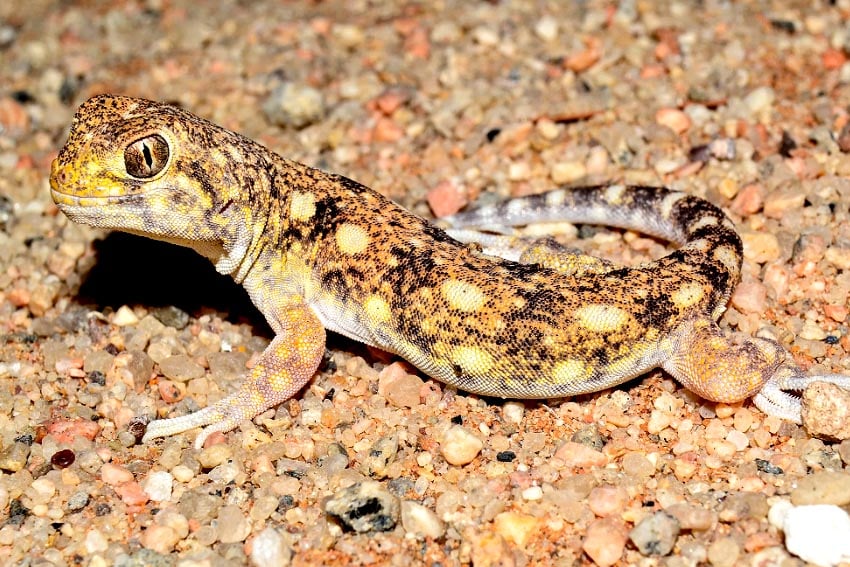
Spotted or Damaraland Barking Gecko (Ptenopus maculatus). Photo: François Becker.
DNA analysis confirmed that they are indeed two distinct species. North of the Kuiseb lives the spotted or Damaraland barking gecko (Ptenopus maculatus). South of the Kuiseb, one finds a species that Becker has named the interdune barking gecko (Ptenopus circumsyrticus).
Nine distinct species of barking gecko
The habitats of these two gecko species differ primarily in the composition of the ground. Could it be that adaptation to different soil types led to the emergence of separate species? Becker visited other regions in Namibia where barking geckos are found and where different types of terrain meet.
And sure enough, near Koës in the Kalahari, he once again discovered distinct mating calls—and, consequently, different species. The same was true for areas near Lüderitz in southwestern Namibia and near Swakopmund. Ultimately, Becker demonstrated that there were not three, but nine species of barking geckos.
DNA analysis was necessary for identification, in part because geckos with different calls do not necessarily look different. Put another way: some species appear very similar externally. What all these species do have in common, is that they are quite small.
Giggling geckos cause sleepless night for tourists
François Becker shared other astonishing facts about 'his' barking geckos (see also the report on ScientificAmerican.com). Their most recent common ancestor lived as long as 77 million years ago.
Based on DNA analyses and other data, Becker concludes that the initial divergence into distinct species occurred 26 million years ago—more than 20 million years before the appearance of the mammoth.
Since their call sounds more like a high-pitched giggle (check the audio recording), Becker actually considers the name 'barking gecko' to be a misnomer. He would prefer to call them 'laughing geckos'. Perhaps 'giggling geckos' would be even more fitting.
Tourists who had lost their way and were forced to spend a night in the realm of these geckos certainly didn't find it a laughing matter. There was loud giggling everywhere, yet the giggling creatures remained nowhere to be seen. When they met Becker the next morning, they could hardly believe that these loud calls came from such tiny and, above all, completely harmless creatures...
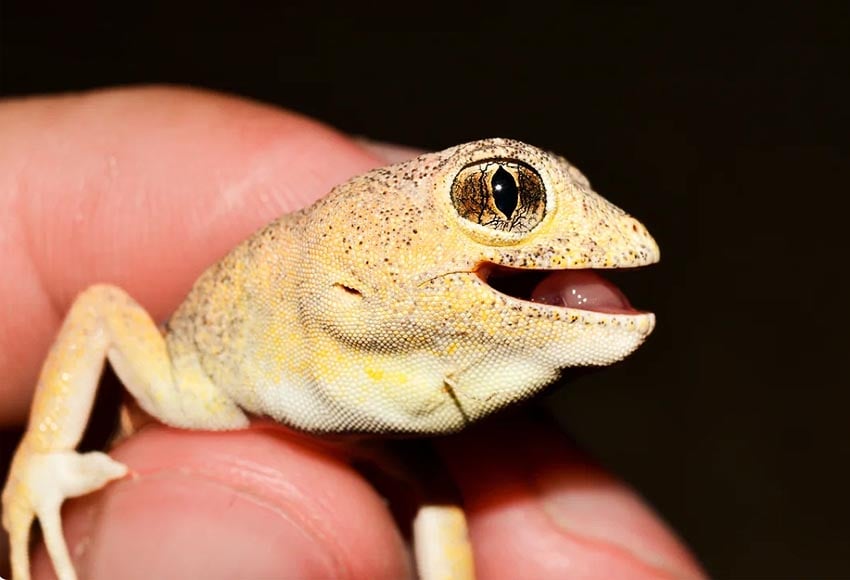
Tiny but loud... A representative of the newly identified barking gecko species Ptenopus sceletus, occurring north of Swakopmund on the Skeleton Coast. Photo: François Becker.



SUBMIT YOUR COMMENT