

In Namibia, stargazers will need to get up early in November. Most of the celestial highlights appear in the morning sky. You won't have to look far to find them, as the action is centred around the constellation Leo. This includes the Leonids meteor shower, as well as two triple 'encounters' involving Moon, Mars and Jupiter...
The Leonids owe their name to the position of their radiant – the area from which the shooting stars appear to originate. This area is located within the constellation Leo. Each year in November, Earth passes through the debris field left by the comet Tempel-Tuttle. Its small particles burn up upon entering our atmosphere.
The annual meteor shower can be observed from 6 to 30 November 2026 – though only during the early morning hours. The radiant rises around 2:00 AM (see page on TimeAndDate.com).
The shower reaches its peak during the night from 17 to 18 November 2026, with an average of 15 meteors appearing per hour. Mathematically speaking, that gives you the chance to make a wish every four minutes.
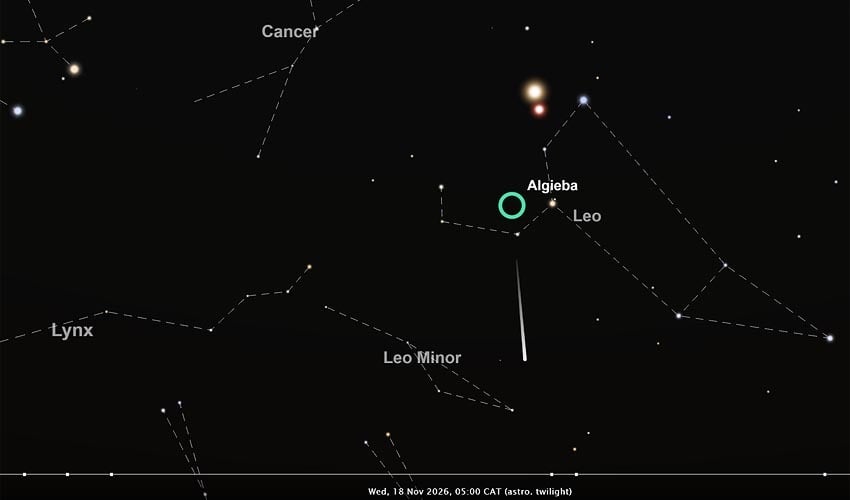
The radiant of the Leonids – a meteor shower with its centre located in the constellation Leo. To the upper left are the stars Castor (left) and Pollux, belonging to the constellation Gemini. – The morning sky on 18 November 2026, at 5:00 AM, as seen from Windhoek, looking toward the northeast. Graphic: Screenshot from star chart on TimeAndDate.com.
In Namibia, those who rise early are also rewarded with a view of four of the five planets visible to the naked eye. Mercury appears on the eastern horizon shortly after 5:00 AM, about an hour before sunrise.
Venus is already higher in the sky by then. It rises around 4:15 AM (times apply to 15 November 2026, in Windhoek; see TimeAndDate.com). On 7 November 2026, the Moon – appearing as a thin crescent – will pass very close to Venus.
Rare conjunction of Mars and Jupiter
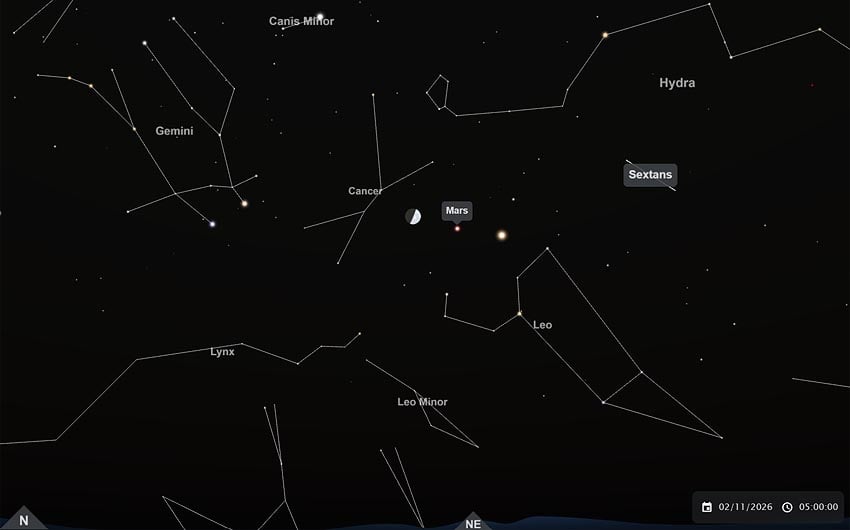
Rare 'meeting' of Mars and Jupiter, which the Moon will join twice during November 2026. – The morning sky on 2 November 2026, at 5:00 AM, as seen from Windhoek, looking toward the northeast. Graphic: Screenshot from interactive star chart on TimeAndDate.com.
Mars and Jupiter offer a true highlight. Throughout the month, they appear almost side-by-side in the morning sky, starting around 1:30 AM. They will be at their closest to one another on 16 November 2026. This is a very rare event. The next so-called conjunction of Mars and Jupiter will not occur again until July 2029.
Night after night, one can clearly observe Jupiter drawing closer to Mars and then passing it by. Of course, this is merely an effect of our own perspective. The setting for this 'encounter' is the constellation Leo. In this light, the Leonids could even be seen as a celebratory fireworks display for this rare event.
While the 'meeting' of Mars and Jupiter is a rare occurrence in itself, the Moon adds an extra layer to the spectacle. It joins the two planets (seen from our vantage point) twice this month: on 2 and 30 November.
The evening sky: Saturn and Scorpius
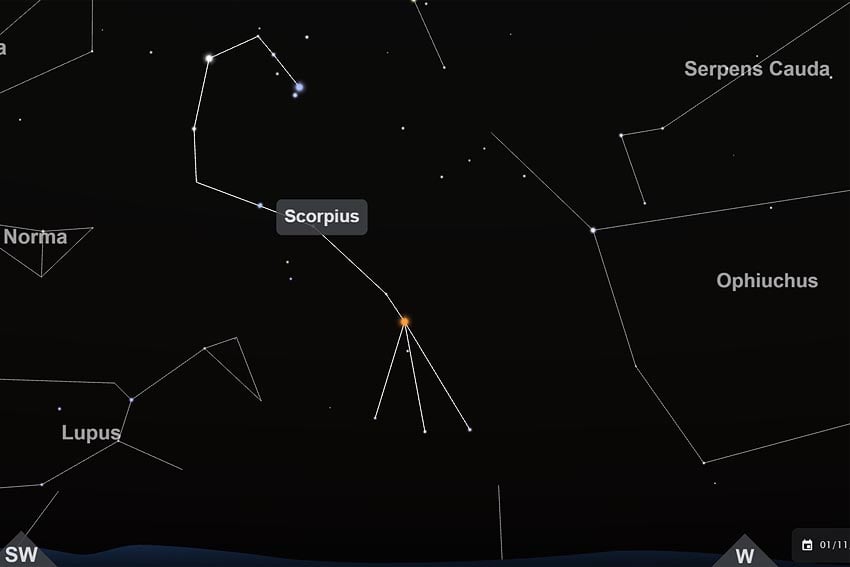
Highlight in the evening sky in early November: the constellation Scorpius. – The evening sky on 1 November 2026, at 8:00 PM, as seen from Windhoek, looking toward the west-southwest. Graphic: Screenshot of interactive star chart from TimeAndDate.com.
The evening sky is somewhat less spectacular. Saturn stands its ground as the only of the five planets visible to the naked eye. At sunset, it is already positioned high in the northeast and it sets around 3:45 AM. On 20 November 2026, the Moon will pay an apparent visit to this ringed planet.
A highlight of the evening sky is the constellation Scorpius, though only during the first part of November. It sets earlier each passing day. Appearing upside down in the west-southwest, its pincers point downward and its curved tail reaches upward. The reddish star located at the point where the pincers branch out is called Antares.
'ED138': A potential new dwarf planet beyond Pluto
Though it remains invisible, even through a telescope: Astronomers have recently reported the discovery of a possible 'new' dwarf planet. As reported by the BBC, it bears the provisional designation '2026 ED138'.
It moves well beyond the orbit of Neptune, the planet farthest from the Sun. Currently, ED138 is approximately 46 astronomical units (AU) from the Sun. For comparison, Neptune's average distance from the Sun is 30.1 AU, while the dwarf planet Pluto is at 40 AU. One AU is defined as the average distance between the Earth and the Sun.
Based on initial data, astronomers estimate that the diameter of ED138 is likely between 600 and 1,500 kilometres, BBC reports. This makes it significantly smaller than Pluto (2,376 km), which was reclassified as a dwarf planet in 2006. For further context, Earth's Moon has a diameter of 3,476 km.
ED138 was discovered by the Vera C. Rubin Observatory in Chile, which houses the world's largest digital camera. We can likely look forward to more exciting discoveries, as the observatory has only just begun a groundbreaking survey of the sky.
Sun and Moon
Sunrise on 1 November 2026 is around 6.06 AM, sunset around 7.03 PM (see TimeAndDate.com). On 30 November 2026, the sun rises at around 5.58 AM and sets at around 7.22 PM. The length of the day (time with sunlight) will therefore increase by 27 minutes over the course of the month – from 12 hours and 57 minutes to 13 hours and 24 minutes.
The phases of the moon in November 2026: last quarter 1 November, new moon 9, first quarter 17, full moon 24 November. Therefore, the nights in the first half of November have the least moonlight, which could interfere with the observation of stars and planets.
You can also find out more about the Namibian starry sky in November 2026 in the Astro News by Lutz von Dewitz in the news section on the website of the Namibia Scientific Society.



SUBMIT YOUR COMMENT