

Only a tiny fraction of Namibian tourists stops over in the Otavi Mountains. Yet, there you can find diverse natural beauty and traces of a rich and varied history. Gaub (also: Ghaub), in the heart of the Otavi Mountains, celebrated its 130th anniversary this year: mission station, farm, hospitality operation and nature reserve.
Of course, the place called Gaub, which means 'spring' in Khoisan languages, has a history spanning millennia. Rock carvings, stone tools, and ancient paths bear witness to this. Not far away, they even discovered bones of the 'Otavipithecus', a distant human ancestor.
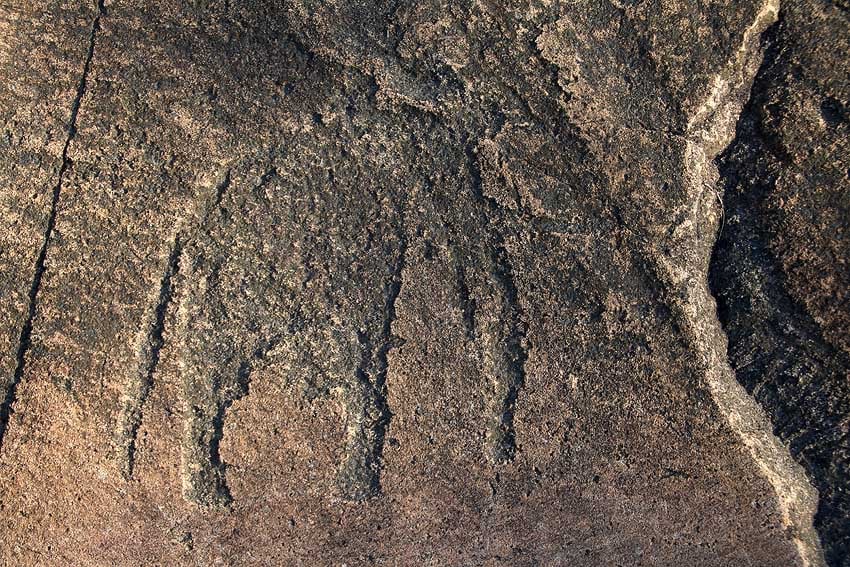
One of the most beautiful rock engravings on Gaub (Ghaub): The elephant. Photo (2019): Sven-Eric Stender
Gaub Mission Station founded in 1895
However, if one considers the buildings that are still standing today, the year 1895 comes to mind. In that year, the Rhenish Missionary Society (RMS) founded the Gaub Mission Station. The intention was to convert the Daman people living there (singular: Dama, two people: Damara, plural: Daman) to the Christian faith.
Five years later, the RMS acquired the 9,000-hectare (90 km²) Gaub farm. The farm was intended to produce food for the small community and generate income for the mission. In 1901, Wilhelm Detering was hired as farm manager. He drained the swamp, created fields, and began raising cattle.
In 1904, the war between the German colonial power and the OvaHerero interrupted the farm's development. The inhabitants fled to Grootfontein, the farm was plundered. Upon his return, Detering laid out orchards and had stones collected from the fields. These were then stacked using dry mortarless construction to build farm walls .
The missionary work on Gaub received a boost in 1911. Missionary Heinrich Vedder founded a centre where locals were trained as evangelists to preach in their own language.
Last Battle of the First World War in Namibia
But three years later came the next setback: the First World War. The last battle between the German colonial troops and the South African army took place on Gaub on 4 July 1915. The graves of two fallen non-commissioned officers can still be found in the small cemetery on Gaub.
Just five days later and a few dozen kilometers southwest, the colonial troops capitulated. The surrender on 9 July 1915, near Khorab, marked the end of the German colonial era in South West Africa.
A similar fate befell the missionary work on Gaub. Among the approximately 6,000 Germans whom the occupying South African forces deported to Germany in 1919 was missionary Vedder. He was allowed to return in 1922, but he continued his work in Okahandja.
Wilhelm Detering, on the other hand, continued farming on Gaub. After his death in 1945, several farm managers succeeded him. However, sustained economic success failed to materialise, likely partly due to the situation of ownership.
Guest farm spelled 'Ghaub'
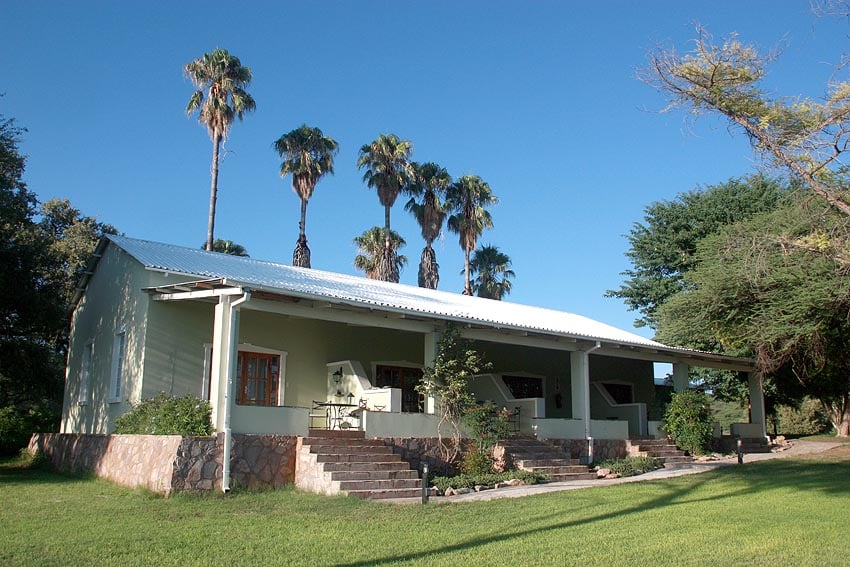
The former missionary's house has served as accommodation for guests of Gaub (Ghaub) since its restoration and renovation in 1996. Photo (2016): Sven-Eric Stender
With Namibia's independence in 1990, tourism experienced a boom. In 1996, RMG sold the Gaub farm to the group Ohlthaver & List. The buildings were restored, and the missionary's house was converted into a guest wing. Two additional buildings with guest rooms were also constructed in the same style.
In addition to maize cultivation and cattle farming, the guest farm thus became an extra source of income. For some inexplicable reason, the guest farm was now spelled 'Ghaub'. In 2007 and 2016, Gaub/Ghaub changed hands again, with each new owner bringing their own approach to its management.
Since 2016, part of the farm has been a nature reserve with about 250 bird species and wildlife such as giraffe, eland, oryx, zebra, and blesbok. Even the vervet monkey (Chlorocebus pygerythrus), which prefers riverbanks, can be found in this spring-rich area. Around 250 bird species make the Otavi Mountains a paradise for bird lovers.
At 'Ghaub Nature Reserve & Farm', you can hike on your own. Game viewing and farm tours are also offered. For fit and adventurous guests, there is a guided tour through Namibia's third-largest cave. This makes a stop at the Otavi Mountains on the way from Windhoek to Etosha or to the Kavango and Zambezi Regions worthwhile – even for those with only a passing interest in history.
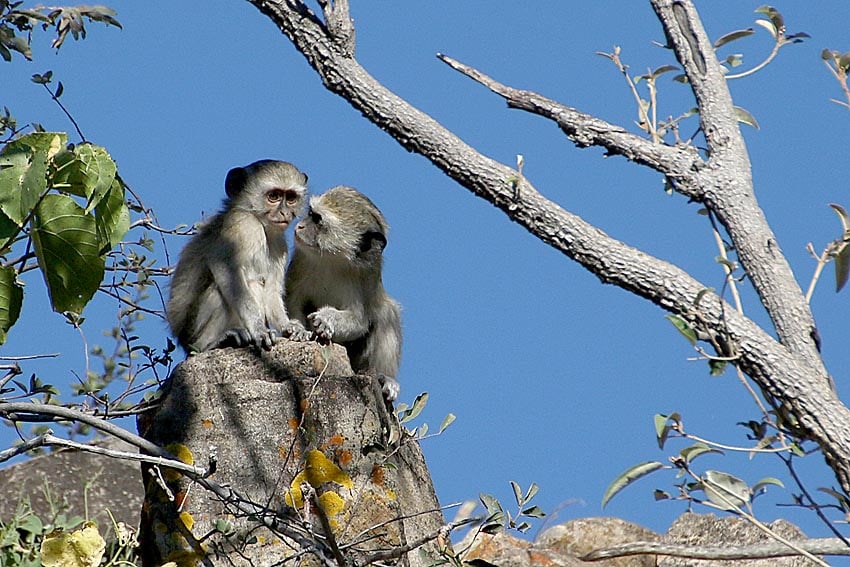
Diverse wildlife on Gaub (Ghaub): Even the vervet monkey (Chlorocebus pygerythrus) is found in the area. Photo (2018): Sven-Eric Stender
.png?width=82&height=85&name=Navigate%20Namibia-03%20(1).png "Navigate Namibia")
SUBMIT YOUR COMMENT