

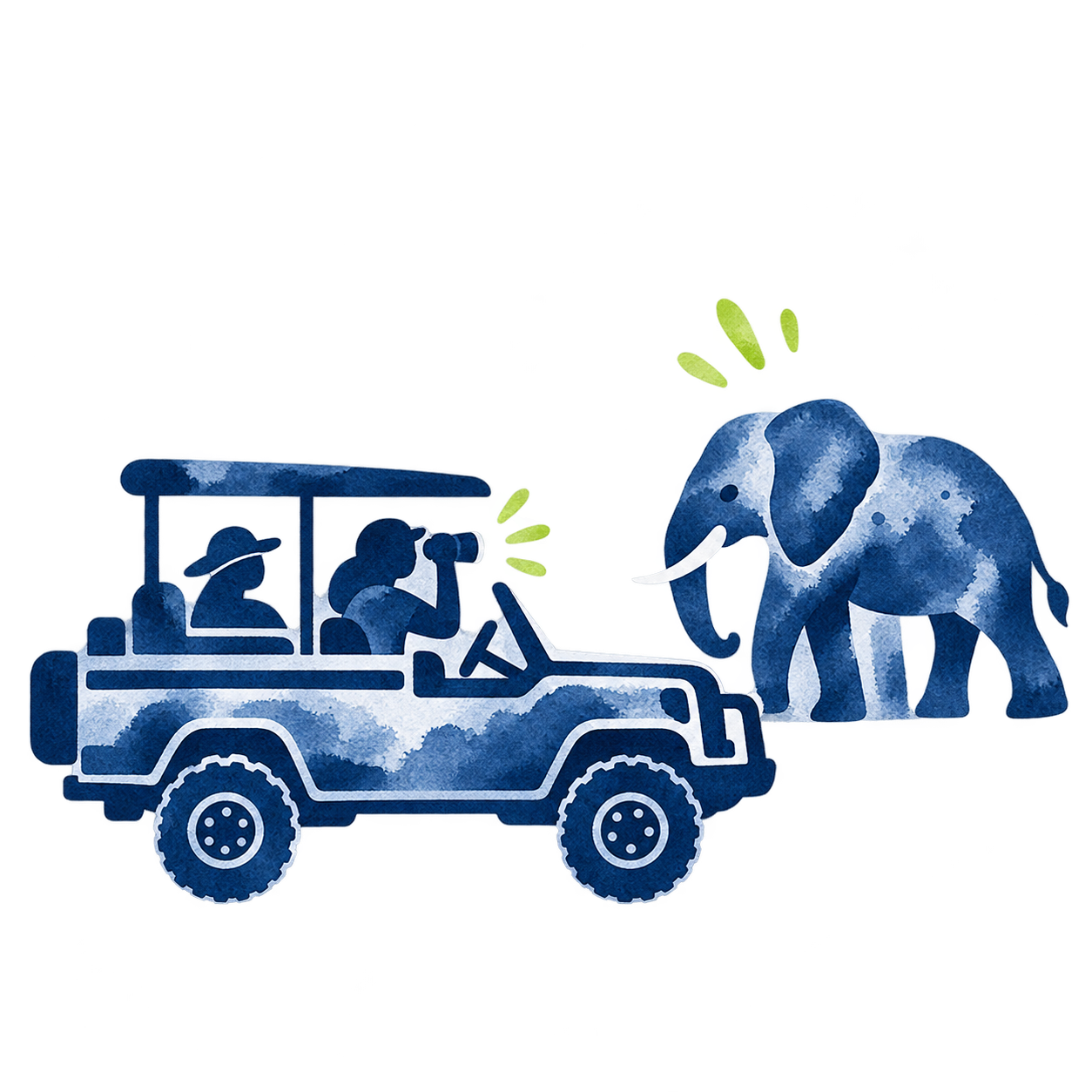
Game Drives & Responsible Wildlife Viewing
Good wildlife viewing is mostly about patience. Drive slowly, give animals space, keep noise down and remember that the best sighting is one that does not change the animal’s behaviour.
There is a particular moment on a Namibian game drive when everybody in the vehicle suddenly becomes an expert tracker.
A shape moves in the grass. Somebody whispers “lion”. Somebody else says “definitely a jackal”. Five minutes later it turns out to be a termite mound.
Wildlife viewing rewards patience.
Slow down
Driving slowly improves almost everything.
You see more, you notice smaller animals and birds, you have more time to react and you are far less likely to disturb wildlife unnecessarily.
At waterholes and sightings, approach quietly and avoid rushing into position.
Give animals space
If an animal changes direction, stops feeding, repeatedly watches your vehicle or appears agitated, you may be too close.
Back off and give it room.
This is especially important around elephants, animals with young, predators on a kill and wildlife moving across the road.
Do not block the road
A good sighting can attract several vehicles very quickly.
Leave enough room for other vehicles to pass and avoid surrounding an animal or preventing it from moving naturally.
If you have had a long look and other people are waiting, moving on is good game-drive etiquette.
Stay on the road
In national parks, remain on designated roads and tracks unless an authorised guide or park rule specifically allows otherwise.
Driving off-road damages vegetation, disturbs animals and can leave tracks that remain visible for a surprisingly long time in arid environments.
Stay in the vehicle
In parks such as Etosha, visitors are not permitted to leave their vehicles outside designated rest camps or authorised areas, except where specifically allowed.
This is not an arbitrary rule. The fact that you cannot see a predator does not mean there is not one nearby.
Use designated viewpoints, hides, picnic areas and rest camps when you need to get out.
Keep noise down
Wildlife does not benefit from car doors slamming, music playing or a vehicle full of people shouting directions at one another.
Speak quietly and keep music off at sightings.
You will generally see more when the animals are behaving naturally rather than reacting to you.
Do not call or bait animals
Do not whistle, play animal calls, use food, rev the engine or make noises to force an animal to look towards the camera.
It may produce a photograph, but it can also disturb feeding, breeding, resting or territorial behaviour.
Never feed wildlife
Feeding wild animals changes their behaviour and can make them dependent on people, aggressive around vehicles or vulnerable to being destroyed later as a problem animal.
A baboon stealing your sandwich may be amusing once. A baboon that has learned that every tourist vehicle contains sandwiches is considerably less amusing.
Waterholes
Waterholes are among Namibia’s best wildlife-viewing locations, particularly during the dry season.
Park quietly, switch off the engine where appropriate and allow animals to approach on their own terms.
Never position the vehicle in a way that blocks an animal’s access to water.
Photography
Take the photograph without changing the scene.
A longer lens is preferable to pushing closer, and flashes should be avoided where they may disturb animals.
If an animal moves away because of you, the photograph was probably not worth getting.
Predators
Lions, leopards, cheetahs and other predators often spend long periods doing absolutely nothing.
This is normal.
Do not pressure an animal to stand, hunt or move simply because your itinerary says you have thirty minutes left before lunch.
Elephants
Give elephants plenty of room, particularly breeding herds and mothers with calves.
Never position your vehicle between members of a herd, block an elephant’s route or deliberately drive close enough to provoke a reaction.
If an elephant appears uncomfortable with your presence, reverse away calmly and allow it space.
Listen to guides and park staff
Professional guides spend far more time reading animal behaviour than most visitors ever will.
If your guide tells you that an animal needs space, that a road is unsafe or that a sighting needs to end, trust the advice.
The best sighting
Wildlife viewing is at its best when the animal is able to carry on as though you are not there.
Be patient, watch quietly and remember that the animal does not owe you a photograph.
.png?width=82&height=85&name=Navigate%20Namibia-03%20(1).png "Navigate Namibia")