

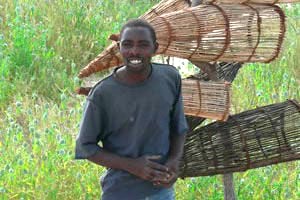
Kavango Communities
Also known as Kavango communities
Kavango is a regional identity shared by several distinct communities living mainly along and around the Kavango River in north-eastern Namibia. These communities are connected by geography, history and neighbouring languages, while retaining their own cultural identities and traditions.
The Kavango River is one of the defining features of north-eastern Namibia. Flowing from Angola through Namibia before entering Botswana as the Okavango, it has shaped settlement, farming, fishing, trade and everyday life along its banks for generations.
But “Kavango” does not refer to one single people. The region is home to several distinct communities, including the VaKwangali, Mbunza, VaGciriku, VaShambyu and Hambukushu, each with their own identity, traditional leadership and linguistic heritage.
Communities and identity
Kavango identity is best understood as both regional and cultural. The river, neighbouring settlements and shared history connect communities across the region, but these connections should not be mistaken for sameness. VaKwangali, Mbunza, VaGciriku, VaShambyu and Hambukushu identities remain distinct, and traditional authorities continue to play a role in community representation and customary affairs.
Historic boundaries and land relationships also remain meaningful. Testimony recorded by Namibia’s Commission of Inquiry into Ancestral Land Rights shows Kavango traditional leaders discussing traditional boundaries, place names, land administration and the historical effects of colonial rule on community territories. This is another reminder that a modern administrative boundary does not necessarily tell the full story of cultural geography.
Language
The linguistic diversity of the Kavango regions is one of their defining characteristics. In the 2023 Census, the most widely spoken home languages in Kavango East included Rukwangali, Rumanyo and Thimbukushu, alongside a range of other languages.
These languages overlap geographically, but they are not interchangeable. Rukwangali is strongly associated with VaKwangali and Mbunza communities, while Rumanyo is associated particularly with VaGciriku and VaShambyu communities; Thimbukushu is closely associated with Hambukushu identity.
Multilingualism is common, especially in Rundu and other areas where communities meet through schools, workplaces, markets and family networks.
The river and everyday life
The Kavango River has long supported livelihoods in ways that are unusually visible in Namibia. Depending on location and household circumstances, these may include crop farming, cattle and other livestock, fishing, gardening, collection of reeds and firewood, wage employment, small businesses and trade.
Pearl millet, widely known in Namibia as mahangu, remains an important crop in many rural areas. Maize and sorghum are also grown, while livestock contributes to both household livelihoods and social life.
Modern census data reinforces how varied livelihoods now are. Salaries and wages are the main source of livelihood for many households, while subsistence farming remains especially important in rural areas. Kavango life cannot therefore be reduced to subsistence agriculture.
Rural and urban Kavango
Rundu is central to the contemporary story. As the capital of Kavango East, it is one of Namibia’s most important northern urban centres and a major hub for education, retail, transport, government and regional trade.
Urban Kavango life includes schools, colleges, offices, shops, churches, informal businesses, transport networks and increasingly diverse neighbourhoods. At the same time, rural communities remain a major part of the region, particularly in Kavango West.
Family networks frequently connect these worlds. Someone may work or study in Rundu while maintaining close ties to a village, agricultural land or relatives elsewhere in the region. Modern life here is therefore not a choice between “traditional” and “urban”. The two continually overlap.
Traditional leadership
Traditional authorities remain visible institutions across Kavango East and Kavango West. Government records recognise authorities including Uukwangali, Mbunza, Gciriku, Shambyu and Hambukushu, with their own leadership structures and areas of customary responsibility.
Their roles can include customary leadership, community representation and aspects of communal land administration, although these operate alongside Namibia’s elected local, regional and national government structures.
Culture and knowledge
Cultural traditions differ between Kavango communities, so it would be misleading to speak of one uniform “Kavango culture”. Across the region, cultural life may include oral history and storytelling, music and dance, basketry and woodwork, farming knowledge, fishing traditions, food preparation, ceremonies, family and kinship traditions, and knowledge connected to rivers, soils and seasonal change.
Where Namibian.org discusses a particular tradition in detail, it should attribute it to the relevant community whenever possible rather than simply labelling it “Kavango”.
Kavango Namibia today
The contemporary Kavango regions are changing rapidly. Education, urbanisation, transport, mobile technology and employment have expanded the range of ways people live and work. Rundu continues to grow as a regional centre, while smaller settlements remain closely connected to the river, farming and communal land.
At the same time, language and community identity remain important. Traditional leadership continues to function, family networks span towns and rural settlements, and cultural knowledge is transmitted alongside newer forms of education and employment.
This is perhaps the best way to understand Kavango identity today: not as a traditional river culture being replaced by modern life, but as several communities continually adapting while maintaining strong connections to place, family and language.
Visiting the Kavango regions
For travellers, the river is an obvious part of the experience, but the region is more than its scenery. Rundu offers markets, shops, restaurants and everyday urban life, while smaller settlements provide a different view of the region’s agricultural and river-based economies.
Visitors interested in culture should favour organised or community-led experiences rather than assuming that ordinary villages are visitor attractions. Ask before photographing people, respect private homes and follow local guidance when entering community spaces.
