


OvaHerero
OvaHerero histories connect Otjiherero, cattle, family institutions and political remembrance with the profound consequences of colonial genocide and dispossession. Related communities share language and historical connections while retaining different names and understandings of belonging.
Names and terminology
Herero (legacy English usage)
- Languages
- Otjiherero and related varieties; multilingual usage
- Geographic associations
- Central, eastern and north-western Namibia, including Otjozondjupa, Omaheke, Khomas and Kunene; residents nationwide
- Scope of this article
- An umbrella identity with internal diversity
- National remembrance
- Genocide Remembrance Day: 28 May
Overview
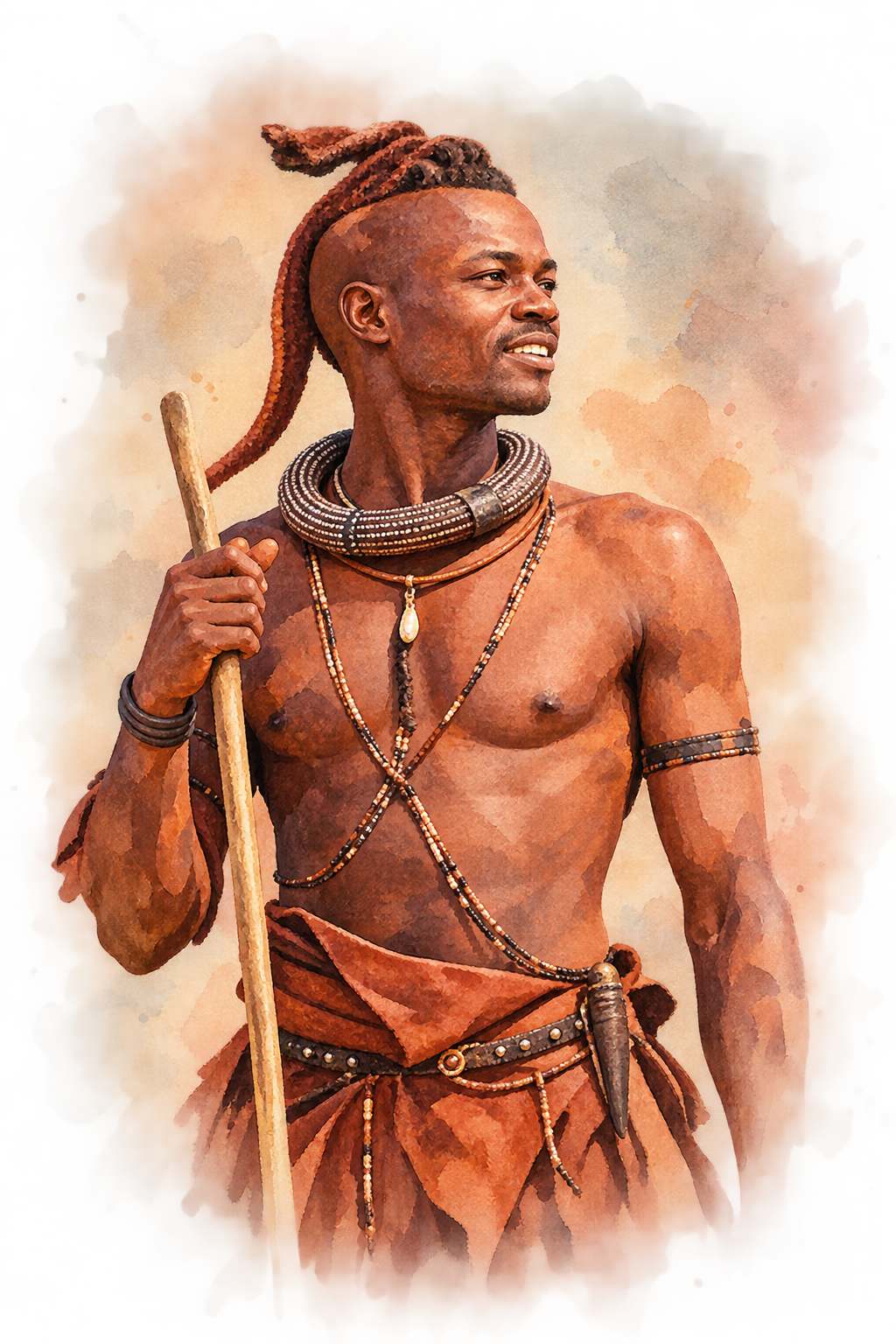
OvaHerero communities have important historical associations with central, eastern and north-western Namibia, as well as wider connections in southern Africa. Otjiherero links people across several identities. Neither shared language nor a broad label should erase the histories and self-identification of OvaMbanderu, Ovahimba or other related communities.
Geographic associations
Central, eastern and north-western Namibia, including Otjozondjupa, Omaheke, Khomas and Kunene; residents nationwide
These associations do not define exclusive territories or the residence of every community member.
Names, language and belonging
Herero is common in English historical writing; OvaHerero is retained here as the community name. There is no single relationship between all the names used within the wider Otjiherero-speaking world. Some people emphasise a distinct community identity, while others use OvaHerero more inclusively.
A particularly important first-person source is the 2024 Biocultural Community Protocol of the OvaHerero of Kaokoland in Namibia and Angola. Its glossary describes OvaHimba as a subgroup and states a preference for OvaHerero of Kaokoland. That is the protocol’s expressed usage, not proof that every person elsewhere uses the same name. This source’s geographic and representative scope matters whenever it is cited.
Livestock, kinship and cultural expression
Cattle have economic, social and ritual significance in OvaHerero histories. They connect livelihoods with family relationships and knowledge of grazing and water. These associations do not mean that every OvaHerero household owns livestock or depends on pastoralism.
Women’s long dresses and distinctive headdresses, and commemorative uniforms, are prominent forms of cultural expression. Their meanings belong to their wearers and communities. Clothing is neither a test of identity nor evidence that culture has remained unchanged. The Museum of Namibian Fashion documents historical and contemporary design and has involved OvaHerero contributors in reviewing its Otjiherero exhibition material.
Colonial rule, resistance and genocide
Germany declared a protectorate in 1884; its effective colonial control expanded through treaties, settlement and military violence rather than appearing everywhere at once. In 1904, OvaHerero resistance was followed by the German campaign at Waterberg, pursuit into the Omaheke and an extermination order. Survivors also endured imprisonment and forced labour. The genocide against OvaHerero and Nama is generally dated 1904–08.
The consequences extended beyond deaths: loss of land, livestock and political autonomy, dispersed families and coercive labour reshaped society. Numerical estimates of victims vary with uncertain pre-war population baselines. An exact death toll should not be presented as settled fact. The genocide’s seriousness does not depend on adopting one contested figure.
Remembrance and rebuilding
Commemorations in Okahandja honour Samuel Maharero and other leaders and connect family memory with public history. They involve more than one organisation and may take place on different dates; “Red Flag Day” should not be presented as a single fixed annual visitor appointment. Remembrance also includes debates over land, representation, the return of human remains and reparative justice.
Namibia designated 28 May as Genocide Remembrance Day by proclamation in 2024, effective from 2025. This national observance is separate from community commemorations. Neither a state ceremony nor a government negotiation automatically represents the views of every descendant community.
Contemporary life and learning
The 2023 Census records OvaHerero residents across different regions, including urban Khomas. Their lives cannot be understood only through rural livestock keeping. Family institutions and commemorations exist alongside education, employment, urban residence and varied personal choices.
For visitors, guided historical interpretation and community accounts are more informative than treating dress as a spectacle. Ask permission before photographing people, graves or ceremonies. Check arrangements directly with organisers, and approach genocide sites as places of remembrance.
Sources and review
Sources: Namibia Statistics Agency, 2023 Census main report, ethnicity tables; NSA, Khomas 2023 Census regional profile, ethnicity tables; OvaHerero of Kaokoland in Namibia and Angola, Biocultural Community Protocol, 2024, especially introduction and glossary; Museums Association of Namibia, Museum of Namibian Fashion, community review and 2024 update; German Federal Archives, archival documents on the war against the Herero; Jürgen Zimmerer, resistance and genocide, Federal Agency for Civic Education, 2014; Government Gazette 8373, Proclamation 19 of 2024, Genocide Remembrance Day; NAMPA, Samuel Maharero commemoration reporting, 2026; Dialogue on Namibia’s Past, July 2026 organiser programme and commemoration record. Reviewed 7 October 2026. Census references describe the 2023 enumeration; later publication dates do not make them 2026 population counts.


.png)

.png?width=82&height=85&name=Navigate%20Namibia-03%20(1).png "Navigate Namibia")