
San Communities
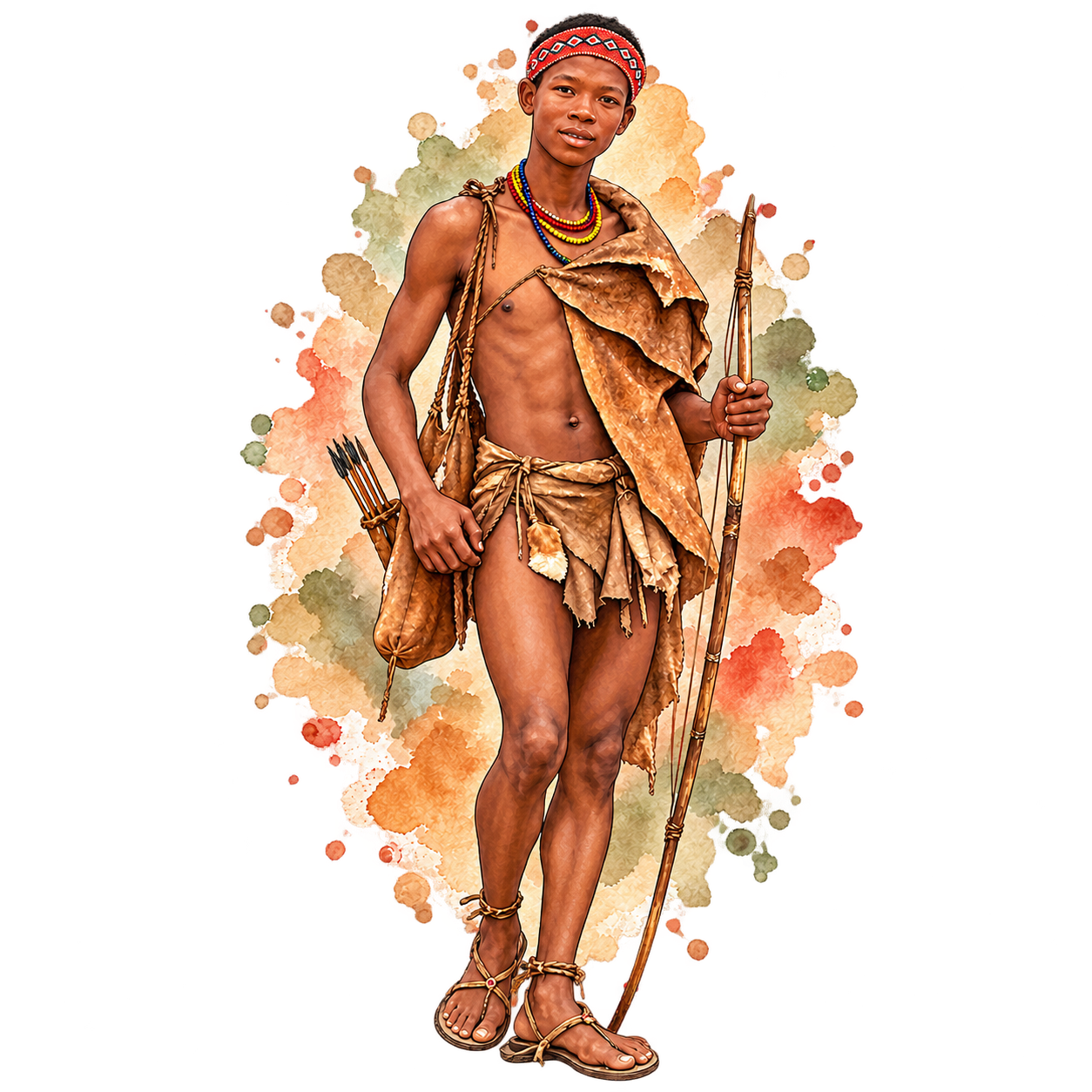
San is an umbrella term for several Indigenous communities with different languages, histories and circumstances. Land, knowledge, displacement, community institutions and contemporary livelihoods are essential to understanding their place in Namibia.
Names and terminology
San (umbrella term); specific community names preferred locally; Bushman (legacy or some self-usage, potentially offensive)
- Languages
- Ju/’hoan; !Xun varieties; Khwe; Naro; Haiǁom varieties of Khoekhoegowab; other languages
- Geographic associations
- Several regions, including Otjozondjupa, Omaheke, Oshikoto, Kavango East, Kavango West and Zambezi; distribution differs by community
- Scope of this article
- An umbrella identity with internal diversity
- Examples of communities
- Ju/’hoansi; Haiǁom; !Xun; Khwe; Naro; others
Overview
Ju/’hoansi, Haiǁom, !Xun, Khwe and Naro are among the community names used in Namibia. Terminology and spelling vary, and broader names such as !Kung require context. These communities do not form one homogeneous people, speak one language or share an identical way of life.
Geographic associations
Several regions, including Otjozondjupa, Omaheke, Oshikoto, Kavango East, Kavango West and Zambezi; distribution differs by community
These associations do not define exclusive territories or the residence of every community member.
Names and languages
San is useful as a broad term in research and public discussion, but specific community names are preferable when the subject is local. Bushman appears in older sources and remains a self-used term for some individuals; it is offensive to others. It should not be imposed on people.
San languages are not one interchangeable language. Haiǁom speech belongs within Khoekhoegowab, also spoken by Damara and Nama communities. Other San communities use different languages. Click consonants occur in more than one language and are not a reliable way to infer a person’s identity.
The 2023 Census uses its own spellings and categories, including !Khung, Hei//om, J’U/hoansi, Kwe/kxoe/Mbarakwengo and San NEC. These should be preserved when discussing a table, rather than silently treated as a definitive linguistic classification. They are not a reason to label every person with the census spelling.
Land and different historical experiences
Research on San communities documents loss of land and resource access, farm labour, resettlement and uneven access to services. The circumstances of Haiǁom, Ju/’hoansi, Khwe and other communities differ. A history centred on Nyae Nyae cannot describe all San in Namibia.
The Nyae Nyae Development Foundation’s account describes the establishment of Tsumkwe as an administrative settlement in 1959 and later efforts by Ju/’hoansi to return to their land and organise representation. Nyae Nyae was gazetted as a communal conservancy in 1998 and registered as a community forest in 2013. These institutions provide specific resource-management rights; they do not resolve every land claim.
In Bwabwata National Park, the Kyaramacan Association represents park residents, mainly Khwe, within the park-resident association framework. It offers another institutional history, with different circumstances from Nyae Nyae.
Knowledge, livelihoods and cultural work
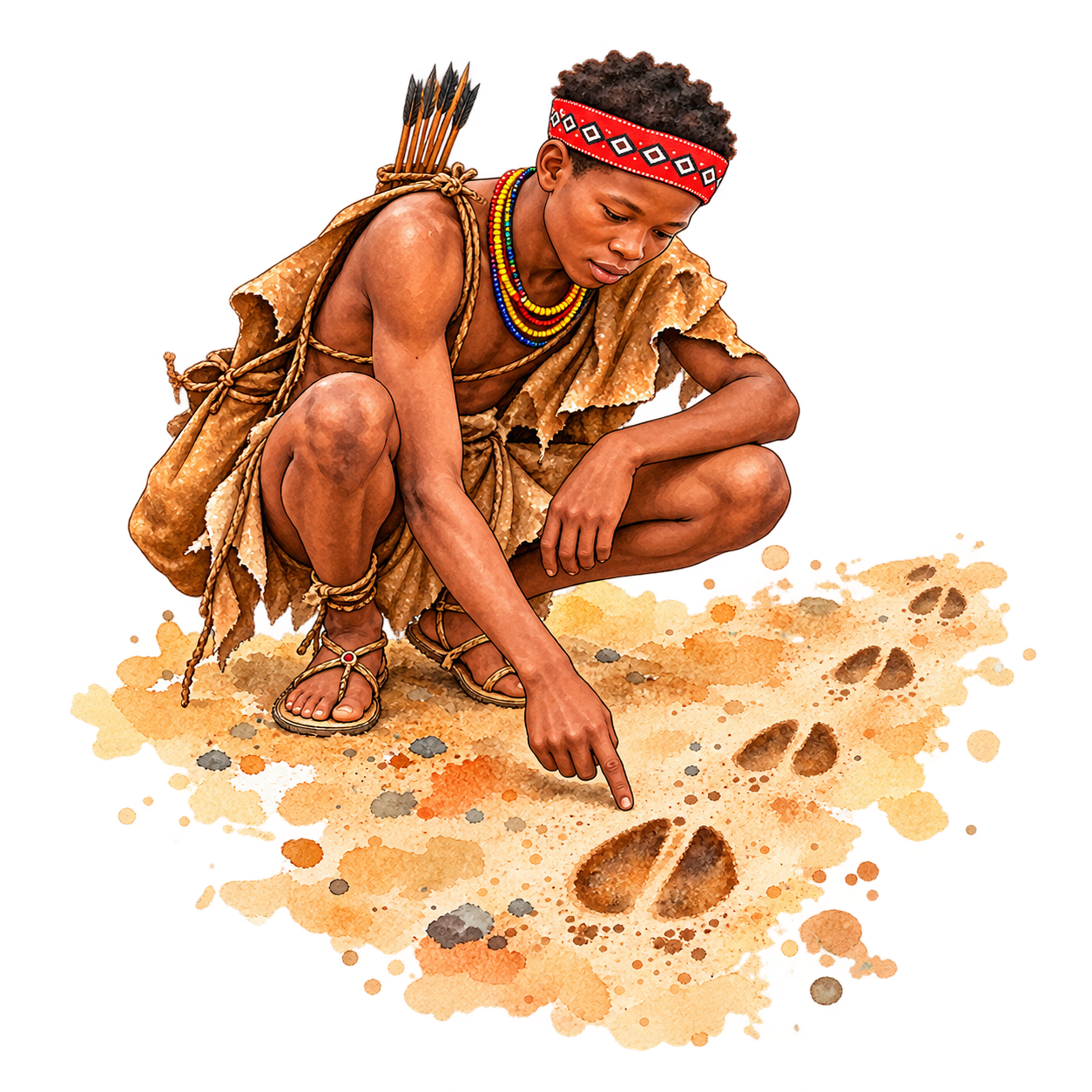
Tracking requires observation, memory and interpretation of animals, terrain and weather. UNESCO-supported tracker training recognises such expertise as knowledge that can be taught and assessed. It should not be explained as an innate racial ability or a skill possessed equally by every San person.
A NUST researcher’s UNESCO account published in January 2026 describes work with Ju/’hoansi in Nyae Nyae on night-sky knowledge and an astrotourism project begun in 2021. This combines locally held accounts with contemporary design and tourism. It is a place-specific example, not evidence that every San community shares the same celestial stories.
Livelihoods can combine wage work, resource harvesting, farming, crafts, tourism and social support. What is possible depends on land access, institutions and household circumstances. A demonstration of hunting or gathering does not establish that these are the participants’ only present-day activities.
Education, services and public policy
The NSA’s Marginalized Communities Profile, published in 2026 from the 2023 Census, explicitly groups San, Ovatue/Ovatwa and Ovatjimba for statistical analysis. They are not one ethnic group. Results for the combined group cannot be attributed to San alone without a separate table.
The report examines education, employment, household services and other dimensions of exclusion. Such evidence points to historical and structural circumstances, not an inherent inability to participate in modern life. Older research remains useful for local histories, but its figures should not be described as current census results.
Namibia’s national outlook on Indigenous and Local Knowledge was launched in July 2026. Recognition of knowledge needs to be accompanied by attention to participation, permission and the benefits received by those who share it.
Visiting respectfully
Choose community-authorised guiding and ask how income reaches participants. Obtain consent before photographs or recordings, especially of ceremonies and knowledge that may have restricted use. Performances are particular presentations, not proof of an unchanged “Stone Age” culture. Clothing, occupation or urban residence does not invalidate Indigenous identity.
Sources and review
Sources: Dieckmann, Thiem, Dirkx and Hays, San in Namibia Two Decades After Independence, 2014, research report mirror; Niklaas Johannes Fredericks, Khoekhoegowab phonology, JULACE 7(1–2), published 2024; Namibia Statistics Agency, 2023 Census main report, ethnicity tables; Nyae Nyae Development Foundation, community history and conservancy, 2018; NACSO, park-resident community associations, ≠Aonin and Kyaramacan; UNESCO, tracker training and Indigenous knowledge; Sisco Auala, NUST, community work in Nyae Nyae, UNESCO, January 2026; NSA, Marginalized Communities Profile, 2023 Census, published 2026; UNESCO, Namibia’s national Indigenous and Local Knowledge outlook launch, July 2026. Reviewed 7 October 2026. Census references describe the 2023 enumeration; later publication dates do not make them 2026 population counts.

.png?width=82&height=85&name=Navigate%20Namibia-03%20(1).png "Navigate Namibia")