

Two meteor showers. A 'double date' of the Moon with Venus and Mercury. And Saturn in opposition to the Sun, bringing it off. There is plenty to observe in the Namibian night sky this October – not just shortly after sundown, but also long before breakfast...
In the evening sky, you can observe the Draconids, a meteor shower with its radiant (centre point) located in the constellation Draco (dragon). It is active from 6 to 10 October. Peak activity occurs on the night of 8 to 9 October, with an average of five to ten shooting stars per hour.
However, the dust and debris from the parent comet are unevenly distributed, which can lead to 'meteor storms'. In 2018, around 150 shooting stars per hour were counted. In 2011, there were about 300 per hour, in 1998 ca. 720, and in 1933 as many as 6,000 (see the Wikipedia article).
The Draconids are visible only in the evening. At sunset, their radiant is already positioned low in the north-northwest. You can locate the area from which most of the shooting stars appear to originate beneath the star Vega in the constellation Lyra. Vega is the fifth-brightest star in the sky.
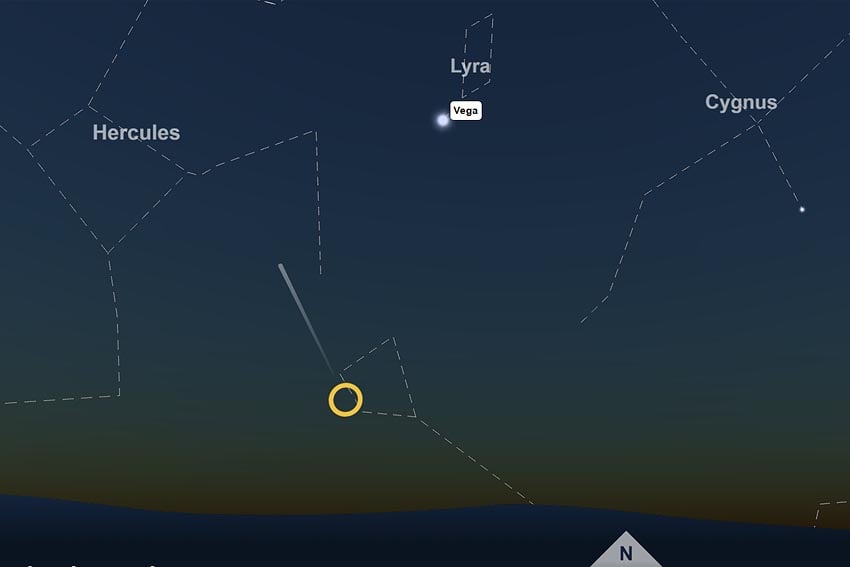
The radiant (centre point) of the 'Draconids' meteor shower is located in the constellation Draco (dragon), below Vega. – The evening sky on 8 October 2026, at 7:15 PM, viewed from Windhoek, looking north-northwest. Graphic: Screenshot of star map on TimeAndDate.com
'Double date' of the Moon with Mercury and Venus
Furthermore, the evening sky offers a view of three of the five planets visible to the naked eye. Venus emerges deep in the west from the fading glow of the setting sun and sets as early as 7:50 p.m.
Mercury follows her around 8:45 PM (all times apply to October 15, 2026, unless otherwise stated; see TimeAndDate.com). The innermost planet of our solar system reaches its point of greatest elongation from the Sun on 12 October, positioning itself well for observation.
Saturn is in opposition to the Sun on October 4: Earth reaches a point between Saturn and the Sun. Consequently, Saturn rises at roughly the same time the Sun sets and sets shortly before sunrise. It can be seen low in the east in the evening and low in the west in the morning. On 24 October, the Moon makes an (apparent) call in on the planet.
A highlight of the evening sky is the Moon's 'double date' with Mercury and Venus on 12 October 2026, low in the west-southwest. Astronomers refer to such an apparent meeting of two celestial bodies as a conjunction. Unfortunately, the trio soon disappears over the horizon.
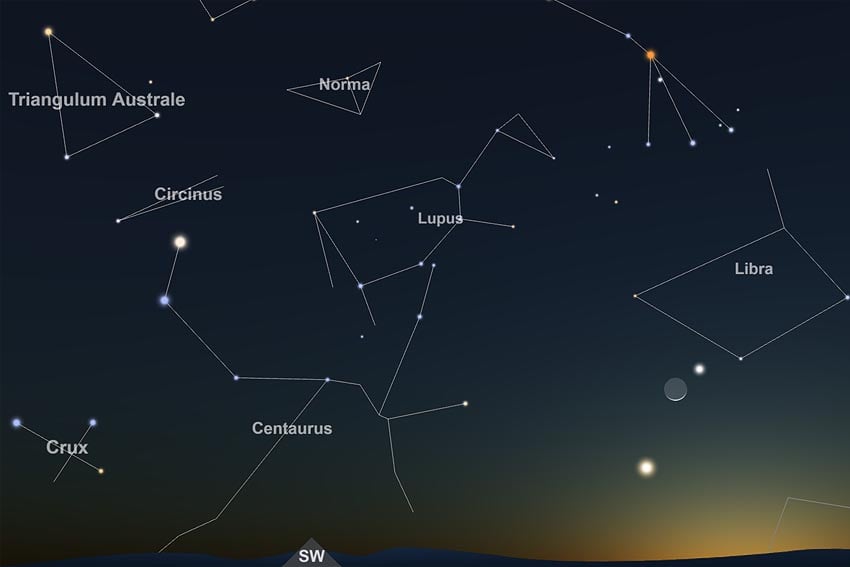
A 'double date' of the waxing Moon with Mercury (to the right) and Venus (below). Further south (to the left) is the Southern Cross (Crux), to its right the constellation Centaurus, featuring the bright star Alpha Centauri. High above the Moon and Mercury are the pincers of the Scorpion (Scorpio), marked by the reddish star Antares. – The evening sky on 12 October 2026, at 7:30 PM, viewed from Windhoek, looking west-southwest. Graphic: Screenshot of interactive star map on TimeAndDate.com.
Morning sky featuring the Orionids and three planets
If the Draconids in the early October evening sky weren't enough for you, you can additionally enjoy the Orionids in the early morning hours throughout the month. They are active from 2 October to 7 November (see the article on TimeAndDate.com). The peak occurs on the night of 21 to 22 October, with around 20 shooting stars per hour.
The meteors – small fragments of the famous Halley's Comet – appear to originate from the region of the sky near the constellation Orion. Travelling at around 66 kilometres per second, they are among the very fast meteors that often leave long trails of light as they burn out.
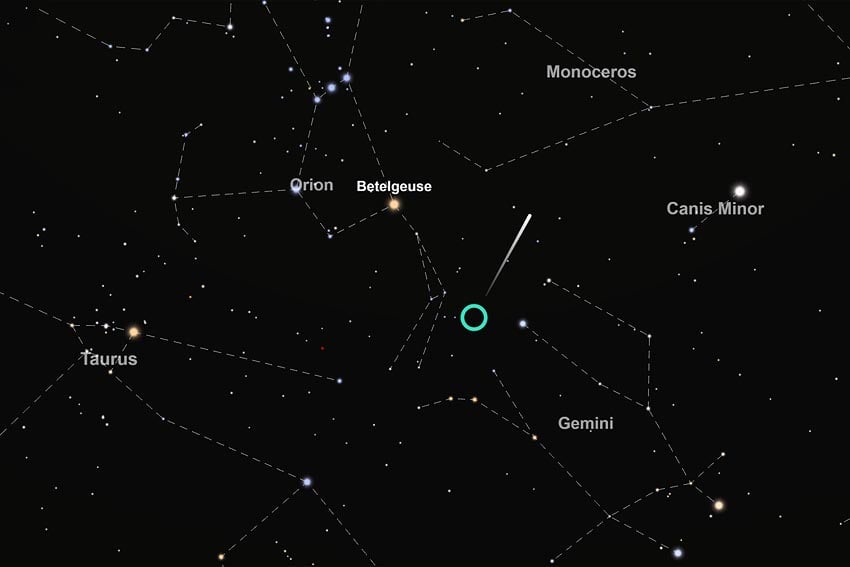
The radiant (centre point) of the 'Orionids' meteor shower is situated between the constellations Orion and Gemini. To the left is Taurus with his reddish 'eye' Aldebaran, and to the right is Canis Minor (Lesser Dog) with its major star Procyon. – The morning sky on 22 October 2026, at 5:00 AM, viewed from Windhoek, looking north. Graphic: Screenshot of star map on TimeAndDate.com.
In addition, three planets can be observed in the morning sky. Saturn is already low in the west and sets around 5:55 AM. Mars and Jupiter, on the other hand, do not begin their paths in the east until around 2:40 AM and 3:20 AM, respectively.
The Moon 'visits' these two 'early risers' one after the other: Mars on 5 October and Jupiter on 6 October 2026. Incidentally, this vividly illustrates the fact that the Moon orbits the Earth – a movement which, in conjunction with sunlight, gives rise to the lunar phases.
Sun and Moon
Sunrise on 1 October 2026 is around 6.32 AM, sunset around 6.50 PM. On 30 October 2026, the sun rises at around 6.07 AM and sets at around 7.03 PM (see TimeAndDate.com). The length of the day (time with sunlight) will therefore increase by 38 minutes over the course of the month – from 12 hours and 18 minutes to 12 hours and 56 minutes.
The phases of the moon in October 2026: last quarter 3 October, new moon 10, first quarter 18, full moon 26 October. Therefore, the nights in the first two thirds of October have the least moonlight, which could interfere with the observation of stars and planets.
You can also find out more about the Namibian starry sky in October 2026 in the Astro News by Lutz von Dewitz in the news section on the website of the Namibia Scientific Society.


.png?width=82&height=85&name=Navigate%20Namibia-03%20(1).png "Navigate Namibia")
SUBMIT YOUR COMMENT