

The early bird catches the worm. Or spots the comets in the sky. This certainly applies to Namibia in March. Mercury and Mars also make an appearance shortly before sunrise. The evening sky offers two planets to admire.
Comet C/2025 A6 (Lemmon) is approaching the 'Pointer' by the day and then moving further towards the Southern Cross. Its path throughout the month follows an arc not far below 'Pointer' and the Cross.
Although Comet 'Lemmon' rises in the evening, it is best seen in the early morning – until 5:30 a.m. A very good pair of binoculars is necessary. Better even would be a telescope which some accommodations in Namibia offer.
Comet C/1995 O1 (Hale-Bopp) can only be spotted with a telescope. 'Hale-Bopp' is located relatively constantly in the constellation Octans throughout the month. Its position lies slightly above a point reached by extending the long axis of the Southern Cross downwards approximately six times.
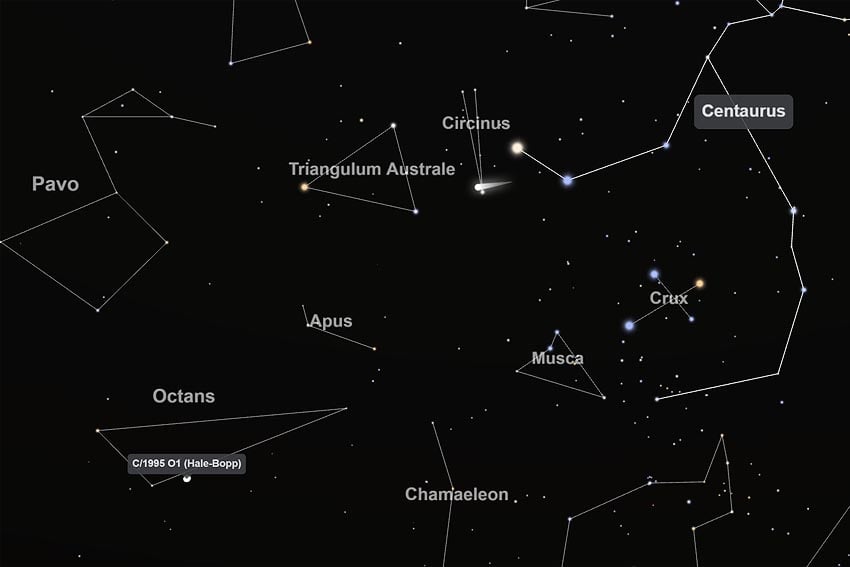
Two comets, C/2025 A6 (Lemmon) and C/1995 O1 (Hale-Bopp), the two stars of the constellation Centaurus that form the 'Pointer', and the Southern Cross: The morning sky on 16 March 2026 at 5:30 a.m., as seen from Windhoek, looking south. Image: Screenshot from interactive celestial map on TimeAndDate.com
For spotting Comet 88P Howell, binoculars are sufficient. 'Howell' moves slowly through the constellation Capricorn throughout the month. Capricorn rises almost exactly in the east at about 5:30 a.m. at the beginning of the month, and 3:30 a.m. at the end of the month.
Only Jupiter visible for hours
Mercury and Mars are located in the constellation Aquarius, below Capricorn. They don't appear on the eastern horizon until around 5:50 a.m. (this and subsequent times refer to 15 March 2026; see TimeAndDate.com). Therefore, they fade very quickly in the increasing light of the approaching sun. End of the month they rise earlier and are better visible.
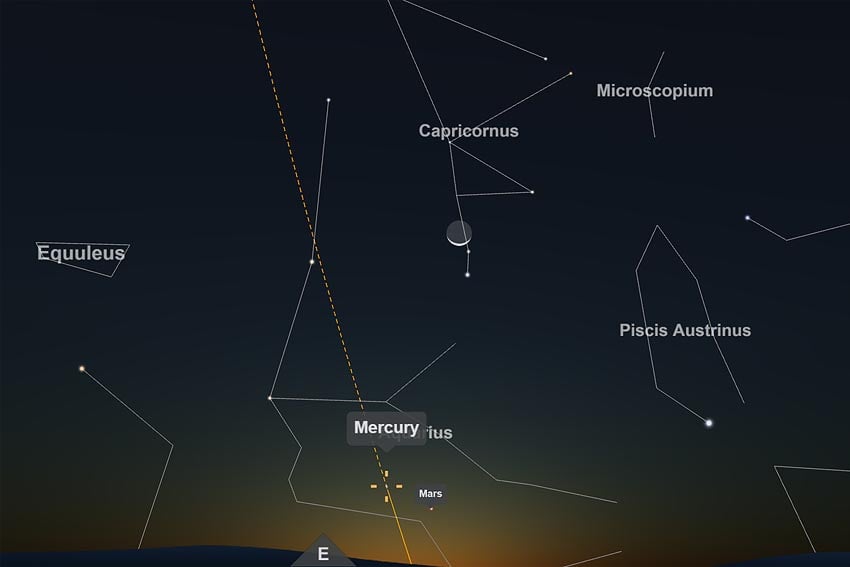
Mercury next to Mars in the constellation Aquarius and, slightly higher above, the thin crescent of the waning moon in the constellation of Capricorn. The morning sky on 16 March 2026 at 6:15 a.m., as seen from Windhoek, looking east. Image: Screenshot from interactive celestial map on TimeAndDate.com
There's less activity in the evening sky regarding moving celestial bodies. Venus is only visible briefly. At sunset, it is already low in the west. It follows the sun after about an hour, around 7:00 p.m. Saturn is even closer to the sun from Earth's perspective and is therefore practically invisible.
Of the five planets visible to the naked eye, only Jupiter remains in the night sky. It is already high in the northeast after dusk and sets around 1:45 a.m. Jupiter can still be found in the constellation Gemini.
Sun and Moon
Sunrise on 1 March is around 6.47 am, sunset around 7.19 pm. On 31 March, the sun rises at around 6.59 am and sets at around 6.52 pm. The length of the day (time with sunlight) will therefore decrease by 19 minutes over the course of the month – from 12 hours and 32 minutes to 11 hours and 53 minutes (see Timeanddate.com).
Autumn begins in Namibia on 20 March. Equinox (Latin prefix 'equi' = equal, 'nox' = night), the day when day and night are of equal length, is on 25 / 26 March.
The phases of the moon in March: full moon 3 March, last quarter 11 March, new moon 19 March, first quarter 25 March. The moonlight is therefore least disruptive to the observation of stars and planets from mid to late March.
You can also find out more about the Namibian starry sky in March in the Astro News by Lutz von Dewitz in the news section on the website of the Namibia Scientific Society.

.png?width=82&height=85&name=Navigate%20Namibia-03%20(1).png "Navigate Namibia")
SUBMIT YOUR COMMENT