

The meteor shower season is over for now. Nevertheless, June has a few nice astronomical events to offer: a 'divine rendezvous' and a 'fleeting encounter' between our moon and a planet. In addition, stargazers in Namibia enjoy the longest night of the year.
After the (almost guaranteed) colorful sunset at about 6:15 p.m., three planets can be spotted above the horizon in the west-northwest. Mercury, the innermost planet of our solar system, is located in the constellation Gemini. It sets about an hour after the sun, around 7:30 p.m.
Venus is located slightly higher in the sky above Gemini. It sets around 8:40 p.m., and Jupiter another half hour later, around 9:15 p.m. (all times refer to June 15; see TimeAndDate.com).
The mentioned 'divine rendezvous' takes place on 9 June 2026: Jupiter and Venus will come very close to each other. However, Venus seems unimpressed, as it will move away day by day toward the constellation Leo.
Meanwhile, Mercury will be travelling through the constellation Gemini, approaching Jupiter at the end of June, as if trying to comfort it. Of course, these events only occur from our perspective. The three planets are orbiting far apart.
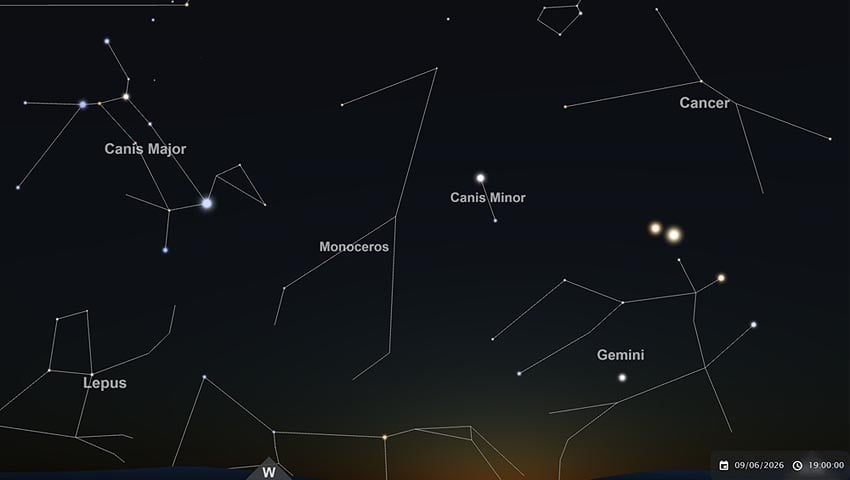
Divine rendezvous: Jupiter (left) and Venus 'meet' above the constellation Gemini, while Mercury (below) watches on. The Gemini stars Pollux (close to Venus) and Castor (below) shine brightly alongside Sirius in Canis Major and Procyon in Canis Minor... The evening sky on 9 June 2026 at 7:00 p.m., as seen from Windhoek, looking west-northwest. Image: Screenshot from interactive star chart on TimeAndDate.com
Moon 'meets' Saturn
An apparent encounter also occurs in the morning sky on the same night. In the early morning of 10 June 2026, the Moon and Saturn will 'meet'. With a little patience, you can even see the Moon slowly moving on its route past the ringed planet.
Besides Saturn, Mars will be visible in the morning sky, but only briefly. While Saturn rises around 3:00 a.m., Mars does not become visible in the east until shortly after 5:00 a.m. Both will fade from view in the light of the rising sun around 7:00 a.m.
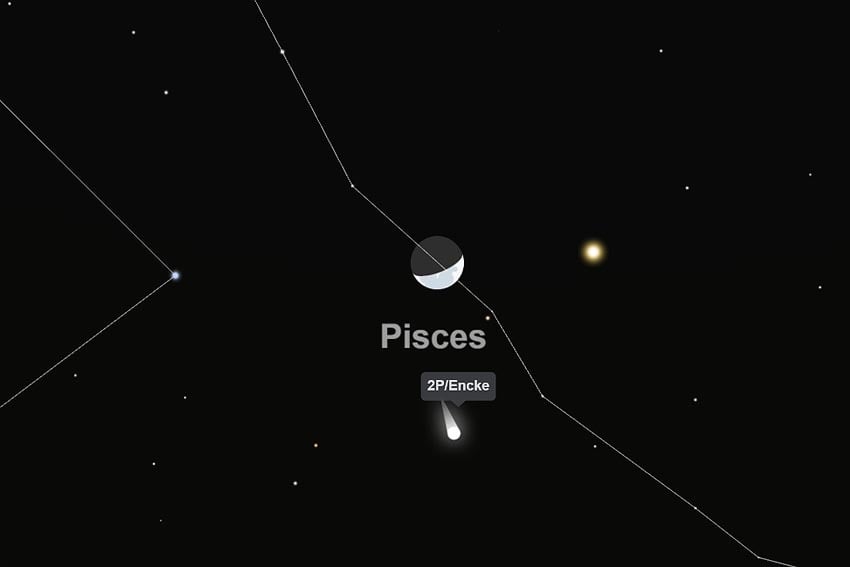
'Fleeting encounter' of the Moon and Saturn. Comet 2P/Encke is easily visible, but only with a telescope. The morning sky on June 10, 2026, at 6:00 a.m., as seen from Windhoek, looking northeast. Image: Screenshot from interactive star chart on TimeAndDate.com
Sun and Moon
Sunrise on 1 June 2026 is around 7.24 a.m., sunset around 6.25 p.m. On 30 June 2026, the sun rises at around 7.32 a.m. and sets at around 6.18 p.m.
The length of the day (time with sunlight) will decrease by 5 minutes until 21 June – to 10 hours and 45 minutes (see Timeanddate.com). By 30 June, the length of the day increases again by 1 minute and amounts to 10 hours 46 minutes.
21 June is the shortest day of the year in the southern hemisphere. At the same time, it is the longest night of the year, lasting 13 hours and 15 minutes.
The sun reaches its northernmost point: it is at its zenith at midday at the Tropic of Cancer in the northern hemisphere. They also talk about the summer solstice and the beginning of summer.
While for the southern hemisphere it is the winter solstice and the beginning of winter. From 21 June, this midday zenith point will move a little further back to the south day by day. Until 21 December, when it reaches the Tropic of Capricorn in the Southern Hemisphere.
The phases of the moon in June 2026:
Last quarter 8 June, new moon 15 June, first quarter 21 June, full moon 30 June 2026. Therefore, the nights in mid-May have the least moonlight, which could interfere with the observation of stars and planets.
You can also find out more about the Namibian starry sky in June 2026 in the Astro News by Lutz von Dewitz in the news section on the website of the Namibia Scientific Society.

.png?width=82&height=85&name=Navigate%20Namibia-03%20(1).png "Navigate Namibia")
SUBMIT YOUR COMMENT