

The night sky over Namibia is sparsely populated with planets in February. None of the five planets visible to the naked eye can be seen in the morning sky. They are also scarce in the evening sky.
This is because Venus, as seen from Earth, is close to the sun. It sets about half an hour after the sun, around 8:00 p.m., still during twilight. Mercury follows 20 minutes later (all times are for 14 February; see TimeAndDate.com; location: Windhoek).
Mars, as seen from Earth, is currently behind the sun. It doesn't appear until around 6:00 a.m. during dawn in the eastern sky. It sets around 7:00 p.m., before sunset.
Only Saturn and Jupiter are easily visible in the evening. Saturn is in the northwest in the evening and sets below the western horizon around 9:20 p.m. Jupiter can still be found in the constellation Gemini, high in the northeast. It sets three hours before sunrise around 3:40 a.m.
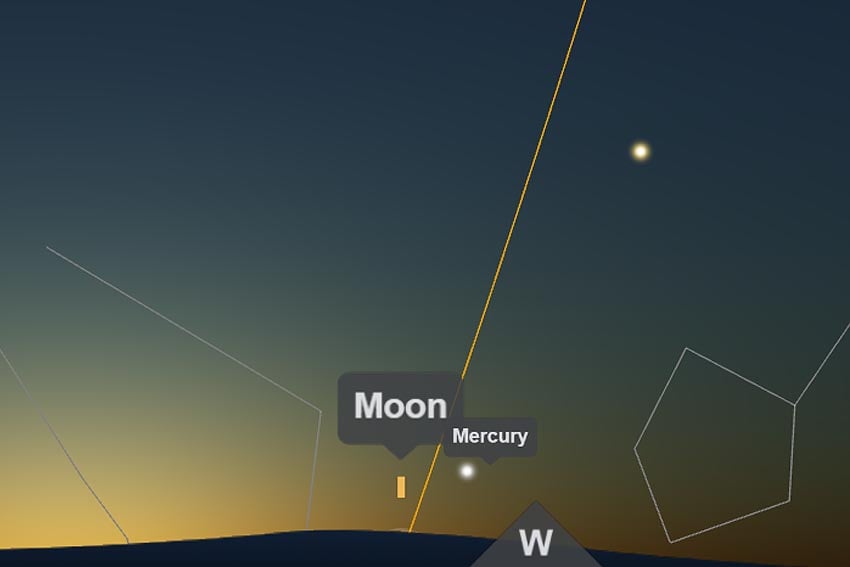
Rendezvous of the Moon and Mercury at dusk, with Saturn (further up) watching: The evening sky on 18 February at 8:00 p.m., as seen from Windhoek, looking west. Image: Screenshot from interactive star chart on TimeAndDate.com
On 18 February, the day after the new moon, Mercury and the moon will be very close together as seen from Earth. Unfortunately, this will happen in the immediate vicinity of the setting sun, low in the west. The thin crescent moon will set shortly after the sun, thus likely to be barely visible in the twilight.
A word of warning: Never look directly at the sun with the naked eye or binoculars – you risk irreparable damage.
Three comets in the evening sky
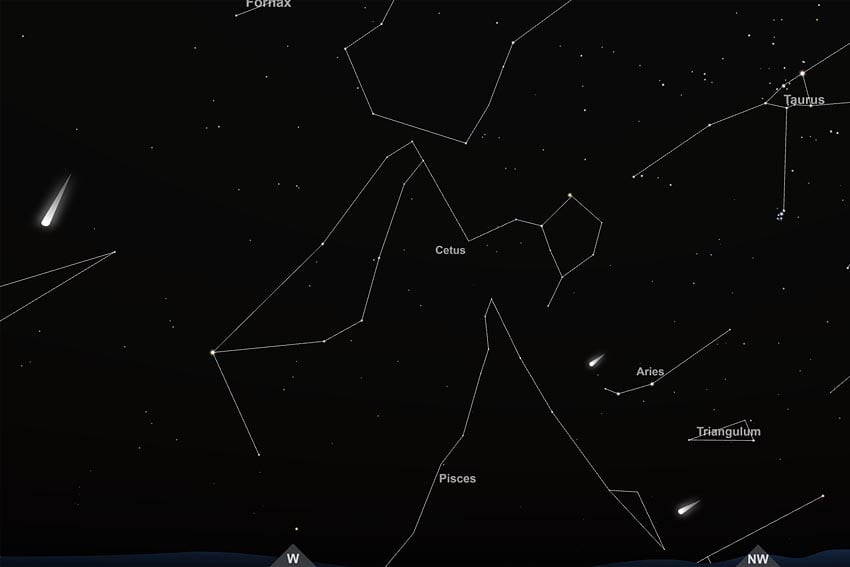
Three comets (from left): C/2024 E1 (Wierzchos), C/2025 R2 (SWAN), and C/2025 K1 (ATLAS). The night sky on 14 February at 9:00 p.m., as seen from Windhoek, looking west. Image: Screenshot from interactive star chart on TimeAndDate.com
From just before 9:00 p.m., three comets can be observed. C/2024 E1 (Wierzchos) is high in the southwest, while C/2025 R2 (SWAN) and C/2025 K1 (ATLAS) are lower in the northwest. Using the constellation Taurus as a guide might help in locating them.
Although most of the celestial highlights in February seem to be restricted to the evening sky, a look at the morning night sky is also worthwhile. Especially before and after the new moon, the Milky Way, with its myriad stars, truly lives up to its name. And the Southern Cross, only rising in the evening, shines brightly high up in the sky.
Sun and Moon
Sunrise on 1 February is around 6.31 am, sunset around 7.38 pm. On 28 February, the sun rises at around 6.47 am and sets at around 7.20 pm. The length of the day (time with sunlight) will therefore decrease by 33 minutes over the course of the month – from 13 hours and 6 minutes to 12 hours and 33 minutes (see Timeanddate.com).
The phases of the moon in February: full moon 2 February, last quarter 9 February, new moon 17 February, first quarter 24 February. The moonlight is therefore the least disturbing when observing the stars and planets at the middle of February.
You can also find out more about the Namibian starry sky in February in the Astro News by Lutz von Dewitz in the news section on the website of the Namibia Scientific Society.
.png?width=82&height=85&name=Navigate%20Namibia-03%20(1).png "Navigate Namibia")
SUBMIT YOUR COMMENT